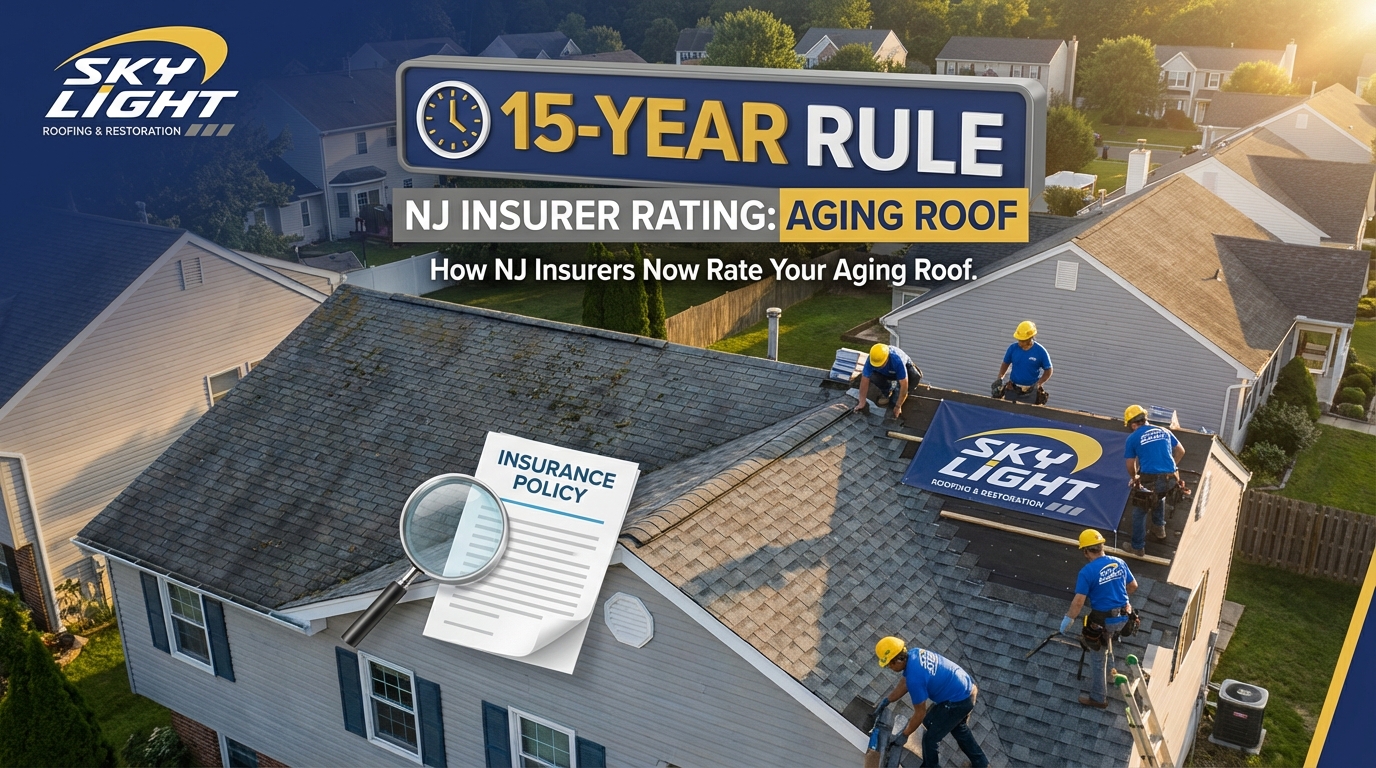
The 15-Year Rule: How NJ Insurers Now Rate Your Aging Roof
The 15-Year Rule: How NJ Insurers Now Rate Your Aging Roof
If you own a home in New Jersey, you may have recently received a startling letter from your insurance provider. It likely mentioned the age of your roof, perhaps suggesting it is nearing a critical threshold. In the Garden State, a new standard has emerged: the "15-Year Rule." This isn't a formal law, but rather a widespread shift in how insurance underwriters assess risk. As roofs hit the 15-year mark, homeowners are finding their premiums skyrocketing, their coverage limited, or worse—receiving non-renewal notices that leave their properties vulnerable. Understanding this shift is no longer optional; it is essential for protecting your financial stability and your home's integrity.
What is the 15-year roof rule for New Jersey insurance? The 15-year roof rule is an underwriting guideline where NJ insurers may transition a policy from Replacement Cost Value (RCV) to Actual Cash Value (ACV) or issue a non-renewal notice if a roof exceeds 15 years of age. This shift occurs because aging roofs are statistically more prone to leaks and storm damage, leading to higher claim frequencies in New Jersey's volatile climate.
1. The New Reality of Homeownership in New Jersey
New Jersey homeowners are currently navigating one of the most challenging insurance markets in decades. Carriers are facing mounting losses due to more frequent and severe weather events, ranging from coastal Nor'easters to inland hail storms. To mitigate these risks, they have turned their focus toward the single most vulnerable part of any structure: the roof. Skylight Roofing & Restoration has observed a significant uptick in clients seeking inspections not because they have a leak, but because their insurance agent has issued an ultimatum. The era of the "30-year shingle" being treated as a 30-year insurance guarantee is over.
This tightening of the screws isn't just about the age of the materials; it's about the financial predictability for the insurer. A roof that is 15 years or older is significantly more likely to fail during a standard wind event than a newer installation. In the eyes of an underwriter, an aging roof isn't just a component of your house—it is a liability waiting to happen. This perspective has fundamentally changed the conversation between homeowners and their insurance providers, moving away from "if" a roof will be a problem to "when" the insurer will stop covering it at full value.
At Skylight Roofing & Restoration, we believe in transparency and preparation. Homeowners who understand these new rules can take proactive steps to avoid being dropped by their carriers. By documenting the condition of your roof through professional, photo-verified inspections, you can often push back against arbitrary age-based decisions. However, the first step in this process is acknowledging that the landscape has changed and that your 15-year-old roof is now a primary focal point for your insurance company's risk assessment team.
2. The 15-Year Milestone: Why NJ Insurers Are Tightening the Screws
3-Tab vs. Architectural Shingles: The Longevity Gap
Not all roofs are created equal, yet many insurers use 15 years as a blanket threshold regardless of the material used. Standard 3-tab asphalt shingles typically have a functional lifespan of 18 to 20 years, meaning that at year 15, they are in their "twilight years." Conversely, architectural (or dimensional) shingles are designed to last 25 to 30 years or more. Despite this technological difference, insurance companies often apply the 15-year rule across the board because the granular loss and seal-strip degradation happen invisibly to the naked eye but predictably over time.
The 4-Point Inspection: The Industry's Gatekeeper
When a home reaches a certain age—often 20 years or older—or when a roof hits the 15-year mark, insurers frequently demand a "4-Point Inspection." This inspection focuses on four critical systems: HVAC, Electrical, Plumbing, and, most importantly, the Roof. The inspector isn't just looking for leaks; they are looking for the "remaining useful life." If the inspector estimates that your roof has fewer than three to five years of life left, many NJ carriers will refuse to issue a new policy or will demand a full replacement as a condition of renewal.
The reason for this scrutiny is simple: statistics. Data from the Insurance Information Institute shows that wind and hail damage account for the largest percentage of homeowners insurance claims. In New Jersey, where wind speeds can reach hurricane force during autumn storms, a 15-year-old roof is considered a high-risk asset. The sealant that holds shingles down becomes brittle over time, making older roofs far more susceptible to "shingle blow-off," which can then lead to massive interior water damage claims that cost insurers tens of thousands of dollars.
3. Understanding the Payout Shift: How RCV Becomes ACV as Your Roof Ages
What is Replacement Cost Value (RCV)?
Most modern homeowners insurance policies are written with Replacement Cost Value (RCV). This means if your roof is destroyed by a covered peril, such as a storm, the insurance company pays to replace it with a new one of similar quality, minus your deductible. For the first 10 to 15 years of a roof's life, this is the standard. It provides peace of mind because you know your out-of-pocket costs are capped at your deductible amount, regardless of how much the price of labor and materials has risen.
The Transition to Actual Cash Value (ACV)
As your roof passes the 15-year mark, many NJ insurers exercise a clause in their contracts that allows them to switch the roof's coverage to Actual Cash Value (ACV). ACV factors in depreciation. If your 20-year-old roof is damaged, the insurer will calculate the cost of a new roof and then subtract the "used up" value of your old roof. If the roof was expected to last 20 years and it's 15 years old, they may only pay 25% of the replacement cost. This leaves the homeowner responsible for the remaining 75%, often totaling $10,000 to $15,000 out of pocket.
This shift represents a massive financial risk. Many homeowners aren't even aware the shift has happened until they file a claim after a storm. They expect a new roof for the cost of their $1,000 deductible, only to receive a check for $3,000 toward a $16,000 project. At Skylight Roofing & Restoration, we emphasize the importance of reviewing your policy's "Roof Surfaces Schedule" annually. Knowing whether you have RCV or ACV coverage is the difference between a minor inconvenience and a financial catastrophe.
4. NJ Weather Factors: Why '15 Years' in NJ Isn't the Same as 15 Years Elsewhere
The Freeze-Thaw Cycle and Ice Damming
New Jersey's climate is particularly brutal on roofing materials. Unlike the constant heat of the south or the steady cold of the north, NJ experiences extreme fluctuations. Our freeze-thaw cycles cause shingles to expand and contract rapidly, which stresses the underlying fasteners and the shingle structure itself. More importantly, these cycles lead to ice damming. When snow melts on a roof and refreezes at the eaves, it forces water under the shingles. On a 15-year-old roof, the underlayment is often degraded, making it incapable of stopping this water from entering the home.
Coastal Proximity: Shore vs. Inland Ratings
If you live in Monmouth, Ocean, or Atlantic County, the 15-year rule is often even more stringent. Coastal homes are subject to salt air, which can corrode metal flashings and fasteners much faster than inland environments. Furthermore, coastal wind speeds are consistently higher. Insurers often apply "Wind and Hail Deductibles" to these properties—which are calculated as a percentage of the home's total value rather than a flat dollar amount. For a $500,000 home with a 2% wind deductible, you're paying $10,000 out of pocket before the insurance pays a dime, making an aging roof an even greater liability.
Humidity also plays a major role in NJ roof aging. Our humid summers promote the growth of Gloeocapsa Magma—the black streaks you see on roofs. While often cosmetic, these algae feed on the limestone filler in shingles, accelerating the loss of granules. By the 15-year mark, a roof in a shaded, humid NJ neighborhood may have lost significant protective mass, even if it looks "okay" from the street. Insurers know this, and their risk models account for the accelerated degradation caused specifically by the Mid-Atlantic climate.
5. The Underwriter’s Eye: How Drones and AI Rate Your Roof
Gone are the days when an insurance agent would drive by your house and glance at your roof from the window of their sedan. Today, insurance companies use sophisticated Geospatial AI and high-resolution satellite imagery to monitor your property. Companies like EagleView and Cape Analytics provide insurers with detailed reports on every roof in their portfolio. These AI systems can detect missing shingles, rusted flashing, overhanging tree limbs, and even the presence of moss or algae—all without the homeowner ever knowing an inspection took place.
This technology allows insurers to be proactive rather than reactive. If the AI flags a roof as "Poor Condition," the carrier may automatically trigger a non-renewal notice or a premium hike. At Skylight Roofing & Restoration, we've seen cases where homeowners were dropped because of "visible debris" on their roof that was nothing more than a few fallen leaves, but the AI interpreted it as damage. This is why having a human expert provide a photo-documented inspection is critical; it gives you the evidence needed to dispute an automated, and often incorrect, AI assessment.
Furthermore, many carriers now use drones for more detailed underwriting inspections. These drones can capture high-definition images of every inch of your roof, identifying granular loss that would be invisible from the ground. While this technology helps insurers price risk more accurately, it places a higher burden on the homeowner to maintain their roof's appearance and structural integrity. If your roof is approaching the 15-year mark, you should assume the insurance company has already "seen" it from above and has already made a preliminary judgment on its condition.
6. NJ Law & Your Rights: What the DOBI Says About Roof-Based Non-Renewals
Mandatory Notice Periods (60-90 Days)
In New Jersey, homeowners have specific protections under the Department of Banking and Insurance (DOBI). An insurance company cannot simply cancel your policy overnight because they don't like the age of your roof. For a non-renewal, carriers are generally required to provide at least 60 days' notice (and often 90 days depending on the policy language) before the expiration date. This window is designed to give the homeowner time to either perform necessary repairs, replace the roof, or find a new insurance carrier. If you receive a notice with less time than this, you may have grounds for a complaint with the DOBI.
Fighting Arbitrary Non-Renewals
New Jersey regulations prevent insurers from being "arbitrary and capricious" in their non-renewal decisions. While age is a valid risk factor, it cannot always be the *sole* factor if the roof is in demonstrably good condition. If your insurer attempts to drop you based on the 15-year rule, you have the right to submit an independent inspection report. This is where Skylight Roofing & Restoration steps in. We provide comprehensive, photo-documented inspections that can prove a roof has years of remaining life, which can sometimes be used to negotiate a continuation of coverage with your agent.
It's also important to understand "Ordinance or Law" coverage in NJ. If you are forced to replace your roof, New Jersey building codes now require specific upgrades, such as ice and water shields and drip edges. If your policy includes Ordinance or Law coverage, the insurance company must pay for these code-required upgrades during a claim. Without it, you are responsible for the cost difference between a standard installation and a code-compliant one. We always recommend NJ homeowners check for this specific endorsement to ensure they aren't left holding the bag for modern safety requirements.
7. The Solar Panel Catch-22: Why Roof Age Matters Most Before Going Green
One of the biggest mistakes we see NJ homeowners make is installing solar panels on a roof that is 12 to 14 years old. Solar companies are often eager to make a sale and may tell you the roof is "fine." However, once those panels are bolted through your shingles and into your rafters, your insurance company views the risk differently. Many carriers will outright refuse to renew a policy on a home with solar panels and a roof over 15 years old. They fear that if a leak occurs, the cost of the claim will skyrocket because the panels must be removed and reinstalled to perform the repair.
The "Solar Trap" is a financial nightmare. If your 15-year-old roof fails under solar panels, you aren't just paying for a new roof; you are paying a solar company $3,000 to $5,000 to "detach and reset" the panels. Most insurance policies do *not* cover the cost of removing solar panels to facilitate a roof repair unless the panels themselves were damaged by a covered peril. This means you could be facing a $20,000+ bill that was entirely preventable had you replaced the roof before the solar installation.
At Skylight Roofing & Restoration, we strongly advise any homeowner considering solar to have their roof professionally evaluated first. If your roof is within 5 years of the 15-year mark, the only financially sound decision is to replace the roof *before* the panels go up. This ensures the roof will last as long as the solar system (25 years) and keeps your insurance company happy. Combining these projects often allows for better integration of flashings and mounting hardware, further reducing the risk of future leaks and insurance disputes.
8. Action Plan: How to 'Insurance-Proof' Your Aging NJ Roof
Professional Certifications of Useful Life
If your roof is hitting that 15-year milestone, don't wait for the letter from your insurance company. Be proactive. Hire a reputable contractor to perform a "Roof Certification." This is a formal document stating that the roof has been inspected and is expected to last a specific number of years (usually 3 or 5). While not all insurers will accept this, many regional NJ carriers will take it into consideration, potentially buying you a few more years of RCV coverage or preventing a non-renewal notice. It shows you are a responsible homeowner who is actively maintaining the property.
Proactive Maintenance vs. Reactive Repair
Small maintenance items can have a big impact on how an insurance AI or inspector views your roof. Replacing a few missing shingles, cleaning off moss or algae, and ensuring gutters are clear and flashings are secure can drastically improve the "score" of your roof. At Skylight Roofing & Restoration, our maintenance plans focus on these "red flag" items that insurance companies look for. By spending a few hundred dollars on maintenance now, you could be saving yourself from a forced $15,000 replacement or a policy cancellation later this year.
Finally, document everything. Keep receipts of any repairs, photos of the roof after maintenance, and copies of your professional inspection reports. If an insurance company tries to claim your roof is in "poor condition," you have a paper trail to prove otherwise. In the world of NJ insurance, the person with the best documentation usually wins. Our team provides photo-documented inspections for every client, ensuring you have the evidence you need to have a fair conversation with your insurance agent.
9. Choosing Your Next Roof: Best Materials for NJ Climate and Insurance Discounts
When the time eventually comes to replace your roof, you shouldn't just look for the cheapest option. Choosing the right materials can actually lower your insurance premiums. Many NJ insurers offer discounts for "Impact-Rated Shingles" (Class 4). These shingles are designed to withstand hail and high winds far better than standard materials. While they cost slightly more upfront, the insurance savings over 10 years, combined with the extended lifespan, often results in a significant return on investment. It's a way to turn a necessary expense into a long-term financial benefit.
Another critical consideration is the underlayment and water barrier. New Jersey building code requires an ice and water shield on the eaves, but we recommend extending this protection to all valleys and critical junctions. This "secondary water barrier" is highly valued by insurers because it prevents the most common types of interior water damage claims. When you can tell your agent that your new roof has a Class 4 impact rating and a reinforced water barrier, you move from a "high-risk" category to a "preferred" category, which can unlock better coverage terms and lower deductibles.
Metal roofing is another growing trend in New Jersey for this very reason. While the initial cost is higher, the lifespan of 50+ years and the inherent fire and wind resistance make it an underwriter's dream. Regardless of the material you choose, the key is to ensure the installation is performed by a manufacturer-certified contractor. Proper installation is the only way to ensure the warranties—both the manufacturer's and the insurance company's willingness to cover the roof—remain valid for decades to come.
10. The 'Financial Decision Matrix': When to Replace vs. Wait
To help you decide whether to replace your roof now or wait, consider this comparison table of the potential costs and risks involved for a typical 2,500 sq. ft. home in New Jersey:
Upfront Cost $14,000 - $18,000 $0 (Initially) Insurance Payout Full RCV (New Roof Value) ACV (Depreciated Value) Premium Impact Possible 5-15% Discount Possible 20-40% Increase Risk of Non-Renewal Near Zero High Solar Compatibility Ideal / Warranty-Safe High Financial RiskAs the matrix shows, while waiting avoids an immediate expense, it exposes you to significantly higher long-term costs and the risk of being uninsurable. In the current NJ market, the most expensive roof is the one you are forced to replace in an emergency with no insurance help. Proactive replacement allows you to choose your contractor, select the best materials, and maintain your RCV coverage, ultimately protecting your home's equity and your family's peace of mind.
At Skylight Roofing & Restoration, we are here to help you navigate these complex decisions. Whether you need a certification to satisfy your insurer, a repair to extend your roof's life, or a full replacement to insurance-proof your home, our team provides the craftsmanship and transparency you deserve. We treat every home as if it were our own, ensuring that your property is respected and your investment is protected against the ever-changing rules of the insurance industry.
Ready to Insurance-Proof Your Home?
We provide complete home renovation services focused on craftsmanship, clean job sites, and clear communication, making the process simple and transparent through photo-documented inspections and a no-pressure experience.
Visit Our Homepage