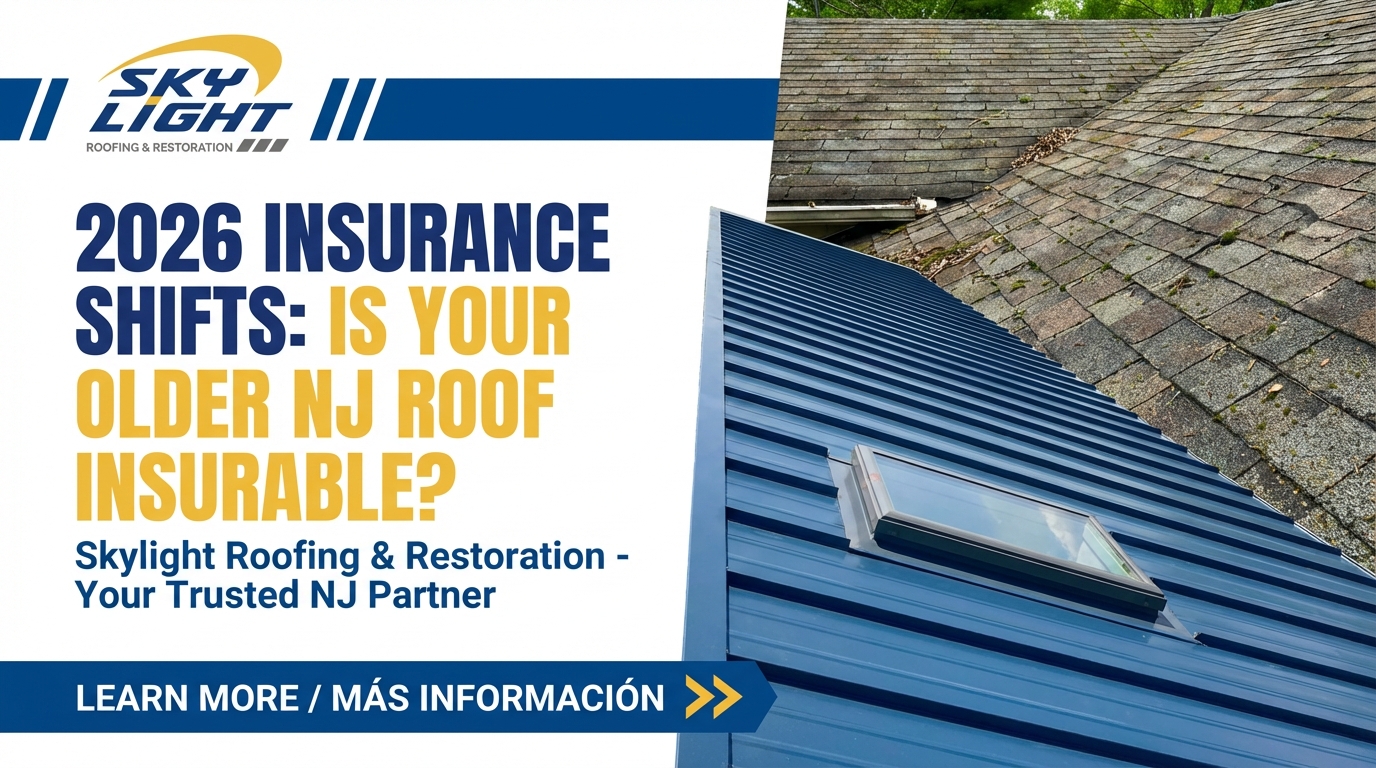
2026 Insurance Shifts: Is Your Older NJ Roof Insurable?
2026 Insurance Shifts: Is Your Older NJ Roof Insurable?
As we move into 2026, the New Jersey real estate and insurance markets are facing a quiet but significant transformation. For years, homeowners viewed their roofs as long-term assets that only needed attention when a leak appeared. However, a major shift in underwriting data and climate risk assessment has changed the game. Today, the question isn't just whether your roof is leaking, but whether an insurance carrier is willing to bet on its survival for another year. If you own a home in the Garden State with a roof reaching the 15-year mark, you are likely standing at a crossroads of insurability.
Quick Answer: In 2026, most New Jersey insurance carriers consider roofs over 15 years old to be high-risk assets. Many providers are transitioning older roofs from Replacement Cost Value (RCV) to Actual Cash Value (ACV) or issuing 30-day non-renewal notices based on AI-driven aerial inspections. Maintaining insurability now requires proactive photo-documented maintenance or upgrading to impact-resistant materials.
At Skylight Roofing & Restoration, we have seen a dramatic uptick in what we call "Panic Calls"—homeowners who receive a letter from their insurance company demanding a full roof replacement within 30 days or face immediate cancellation of their policy. This trend isn't a fluke; it is the result of a coordinated shift in the national insurance landscape that is hitting New Jersey particularly hard due to our unique coastal and inland weather patterns.
I. The 2026 NJ Insurance Landscape and the 'Roof Age Crisis'
The insurance industry in 2026 is grappling with the cumulative costs of "secondary perils"—smaller but more frequent storms, hail, and high-wind events that have plagued the Northeast. In New Jersey, the combination of aging housing stock and increasingly volatile weather has led to what underwriters call a "hard market." This means higher premiums, stricter eligibility requirements, and a zero-tolerance policy for aging infrastructure. The roof is the primary target because it serves as the home's first line of defense; if the roof fails, the resulting interior damage can quintuple the total claim cost.
We are currently witnessing a historic tightening of policy language. Insurers are no longer waiting for a claim to be filed to assess your roof's condition. Instead, they are using predictive modeling to identify which homes are likely to experience a loss in the next 24 months. If your roof is older, it is no longer a matter of "if" you will be contacted by your carrier, but "when." This crisis is particularly acute for NJ residents who have enjoyed the same policy for decades, only to find that their loyalty is not being rewarded in the current underwriting climate.
II. The 15-Year Shift: Why Your Shingles Are Aging Faster in the Eyes of Underwriters
Historically, a 20- or 25-year-old roof was considered the standard threshold for replacement. However, 2026 marks the definitive cementing of the "15-Year Rule" across the industry. Why the change? Modern actuarial data suggests that the structural integrity of standard asphalt shingles begins to degrade significantly after 15 years of exposure to New Jersey's freeze-thaw cycles, high humidity, and salt air. Once a roof passes this milestone, the probability of a total loss during a windstorm increases by over 300%.
Asphalt vs. Architectural Lifespans
It is important to distinguish between different material types. Traditional 3-tab shingles are being phased out of insurability entirely once they hit 12 to 15 years. Architectural (or dimensional) shingles, while more durable, are also facing stricter scrutiny. Even though these materials are often marketed as having "lifetime" warranties, insurance companies are effectively capping their "insurable life" at 15 to 18 years unless a professional photo-documented inspection can prove the roof has years of life remaining.
The Impact of Granule Loss and Brittle Testing
Underwriters are specifically looking for signs of granule loss and shingle brittleness. As shingles age, the oils that keep them flexible evaporate. In a 2026 insurance audit, a "brittle test" is often performed. If a shingle cannot be slightly lifted without cracking, the roof is deemed unrepairable. In the eyes of an insurance company, an unrepairable roof is an uninsurable roof, as any minor damage would necessitate a full, expensive replacement that they would rather avoid covering.
III. The Eye in the Sky: How AI, Drones, and Satellites Determine Your Insurability Before You File a Claim
Gone are the days when an insurance adjuster would climb a ladder to look at your roof once every decade. In 2026, your roof is likely being inspected several times a year by high-resolution satellites and AI-powered drones. Companies like Nearmap and EagleView provide insurers with sub-centimeter imagery that can detect missing shingles, rusted flashing, or even excessive moss growth from miles above. This technology has removed the "benefit of the doubt" that homeowners used to enjoy.
AI Property Intelligence Scores
Insurers now use "Property Intelligence Scores" generated by AI algorithms. These algorithms scan aerial photos to identify specific risk factors: overhanging tree limbs, ponding water on flat sections, or mismatched shingles from previous patch jobs. If your score falls below a certain threshold, a non-renewal notice is automatically triggered by the system, often without a human being ever looking at your file. This automated approach means homeowners must be more vigilant than ever about the visual appearance and structural health of their roofs.
The Rise of Drone Inspections
For more detailed assessments, many New Jersey carriers are now deploying localized drone fleets. These drones can fly within feet of your roof, using thermal imaging to detect moisture trapped under the shingles. This level of detail allows insurers to identify leaks before they even manifest as ceiling stains inside your home. While this technology helps prevent major water damage, it also gives carriers the evidence they need to demand a replacement long before the homeowner thinks it is necessary.
IV. The Financial Blow: Understanding the Pivot to Actual Cash Value (ACV) and Rising Deductibles
One of the most significant 2026 insurance shifts is the move from Replacement Cost Value (RCV) to Actual Cash Value (ACV) for older roofs. Under an RCV policy, if your 20-year-old roof is damaged by a storm, the insurance company pays to install a brand-new roof. Under an ACV policy, the company only pays for the depreciated value of that 20-year-old roof. This can result in a massive financial gap, leaving homeowners to pay tens of thousands of dollars out of pocket for a replacement.
Payout Basis Current cost to buy a new roof. Depreciated value based on age. Out-of-Pocket Usually just your deductible. Deductible + thousands in depreciation. 2026 Availability Typically only for roofs under 15 years. Standard for roofs 15-20+ years old.The 1% Wind and Hail Deductible Mandate
In addition to ACV shifts, many New Jersey policies now feature a mandatory percentage-based deductible for wind and hail damage. Instead of a flat $500 or $1,000 deductible, homeowners are now seeing 1% or 2% deductibles. On a $600,000 home, a 2% deductible means you must pay $12,000 out of pocket before the insurance company pays a dime. This shift effectively transfers the bulk of the risk for "older" roofs back onto the homeowner, making comprehensive restoration planning more important than ever.
V. New Jersey Legislative Response: What Bill A3247 and NJDOBI Regulations Mean for You
In response to the growing number of "uninsurable" homes, the New Jersey state government has stepped in with new regulations and proposed legislation. NJ Legislative Bill A3247 (slated for full implementation in the 2026-2027 cycle) is designed to create a state-led plan for homeowners who find themselves uninsurable by "ordinary methods." This bill aims to prevent mass non-renewals in specific zip codes, particularly those heavily impacted by storm frequency.
Understanding NJDOBI 'Block Non-Renewal' Rules
The New Jersey Department of Banking and Insurance (NJDOBI) enforces strict technical regulations under N.J.A.C. 11:1-22. These rules require insurance carriers to report any "block non-renewals" to the state. A carrier cannot simply decide to stop insuring all 20-year-old roofs in Ocean County overnight without proving that the move is necessary for their financial solvency. If you receive a non-renewal notice, it is worth checking if your carrier is following these reporting guidelines or if they are unfairly targeting your property.
Consumer Protection and Transparency
The new regulations also demand more transparency from insurers. Carriers must now provide specific reasons for non-renewal. Phrases like "roof condition" are no longer sufficient; they must specify whether it is due to age, visible damage, or material type. This transparency allows homeowners to work with insurance claim support experts to address the specific concerns and potentially reinstate their coverage.
VI. Case Study: Coastal vs. Inland NJ Homes—Navigating Different Risk Thresholds
Where you live in New Jersey drastically changes how an insurance company views your roof's age. For homes in coastal areas like Toms River, Belmar, or Cape May, the 15-year rule is often compressed to 10 or 12 years. The salt air accelerates the corrosion of fasteners and the degradation of sealants, making these roofs inherently riskier. Inland homes in counties like Morris or Sussex may enjoy a bit more leeway, but they face their own set of challenges, specifically regarding heavy snow loads and ice damming.
Consider a recent case study: Two identical homes were built in 2010—one in Cherry Hill (inland) and one in Long Beach Island (coastal). In 2026, the Cherry Hill home was offered a policy renewal with a standard $2,500 deductible. Meanwhile, the Long Beach Island home received a non-renewal notice due to the roof being 16 years old. To get coverage, the LBI homeowner was forced to install a high-wind-rated "certified system" with stainless steel fasteners to combat the corrosive environment. This illustrates that "older" is a relative term in the world of NJ insurance.
VII. Action Plan: Steps to Take if You Receive a Notice of Non-Renewal
If you open your mail to find a 30-day notice of non-renewal, do not panic, but do act immediately. Every day counts when you are trying to secure a new policy or negotiate with your current one. Here is the recommended step-by-step process:
- Request the Inspection Report: Ask your carrier for the specific aerial imagery or drone data they used to make the decision. Sometimes, shadows or debris are mistaken for damage.
- Get a Professional Certification: Hire a reputable local roofer to perform a physical inspection. If they can document that the roof has 5+ years of remaining life, you can submit this to the insurance company's underwriting department for a reconsiderations.
- Address Minor Maintenance: Often, simple repairs like replacing a few shingles, cleaning off moss, or painting rusted flashing can satisfy an underwriter's concerns.
- Shop the Secondary Market: Work with an independent agent who has access to surplus line carriers. These companies specialize in higher-risk homes, though their premiums are typically higher.
VIII. The Last Resort: A Homeowner's Guide to the NJ FAIR Plan
If your roof is deemed completely uninsurable by the private market, your final option is the New Jersey Insurance Underwriting Association (NJIUA), commonly known as the NJ FAIR Plan. The FAIR Plan was created to ensure that all New Jersey homeowners have access to basic property insurance. However, it is truly a "last resort" option. The coverage is often limited to basic fire and lightning, and it may not include the broader "all-perils" protection found in standard HO-3 policies.
The FAIR Plan also comes with its own set of requirements. They will still require an inspection, and if the roof is in a state of extreme disrepair, they may issue a "repair or cancel" order similar to a private carrier. Furthermore, relying on the FAIR Plan can make it difficult to sell your home later, as most mortgage lenders prefer traditional insurance coverage. Use the FAIR Plan as a bridge while you save for a roof replacement, not as a permanent solution.
IX. The Solar Panel Trap: The 2026 Challenge for Older Roofs
A unique and growing issue in 2026 is what we call "The Solar Panel Trap." Many New Jersey homeowners installed solar panels between 2018 and 2022 on roofs that were already 10 years old. Now, in 2026, those roofs are 14-18 years old and facing insurance scrutiny. Carriers are increasingly hesitant to insure older roofs with solar installations because if a leak occurs, the cost of removing and reinstalling the panels to perform a repair can add $3,000 to $6,000 to the claim.
If you have solar panels on an older roof, you may find your renewal premiums skyrocketing or your policy being canceled entirely. Some carriers now require a separate "solar endorsement" or will only insure the roof if the panels were installed by a contractor who also certified the roof's remaining life. If you are considering solar in 2026, the industry standard is now clear: never install panels on a roof that is more than 5 years old unless you are performing a full roof installation at the same time.
X. Future-Proofing: Upgrading to Impact-Resistant Materials and Certified Systems for 2026 and Beyond
The best way to navigate the 2026 insurance shift is to "over-build." When it comes time for a replacement, choosing the cheapest option is no longer a sound financial strategy. Instead, look for Class 4 impact-resistant shingles. These materials are engineered to withstand hail and high winds, and many New Jersey insurers offer a permanent 10% to 15% discount on premiums for homes that have them installed. Over the life of the roof, the insurance savings often pay for the upgrade itself.
The Importance of the 'Full System' Warranty
In 2026, insurers prioritize full systems over simple shingle replacements. A "certified system" includes a manufacturer-approved combination of underlayment, ice and water shields, intake/exhaust ventilation, and shingles. When a certified contractor (like GAF Master Elite or Owens Corning Platinum) installs a full system, the manufacturer provides a warranty that is transferable and recognizable by insurance underwriters. This documentation is your strongest weapon when negotiating your insurability, as it proves the roof was built to a higher standard than the minimum building code.
Conclusion: Protecting Your Home Equity Through Proactive Maintenance
The 2026 insurance landscape is undeniably challenging for owners of older homes. However, by understanding the shift toward AI-driven underwriting, ACV payouts, and the 15-year rule, you can take control of your property's future. Proactive maintenance, photo-documented inspections, and strategic upgrades are no longer just chores—they are essential financial investments that protect your home equity and ensure you never find yourself on the wrong side of a non-renewal notice. At Skylight Roofing & Restoration, we are committed to helping you navigate these changes with transparency and expert craftsmanship.
Secure Your Roof's Future Today
We provide photo-documented inspections and transparent repair options with no pressure, ensuring a smooth customer experience through clear communication and expert craftsmanship.
Visit Our Homepage