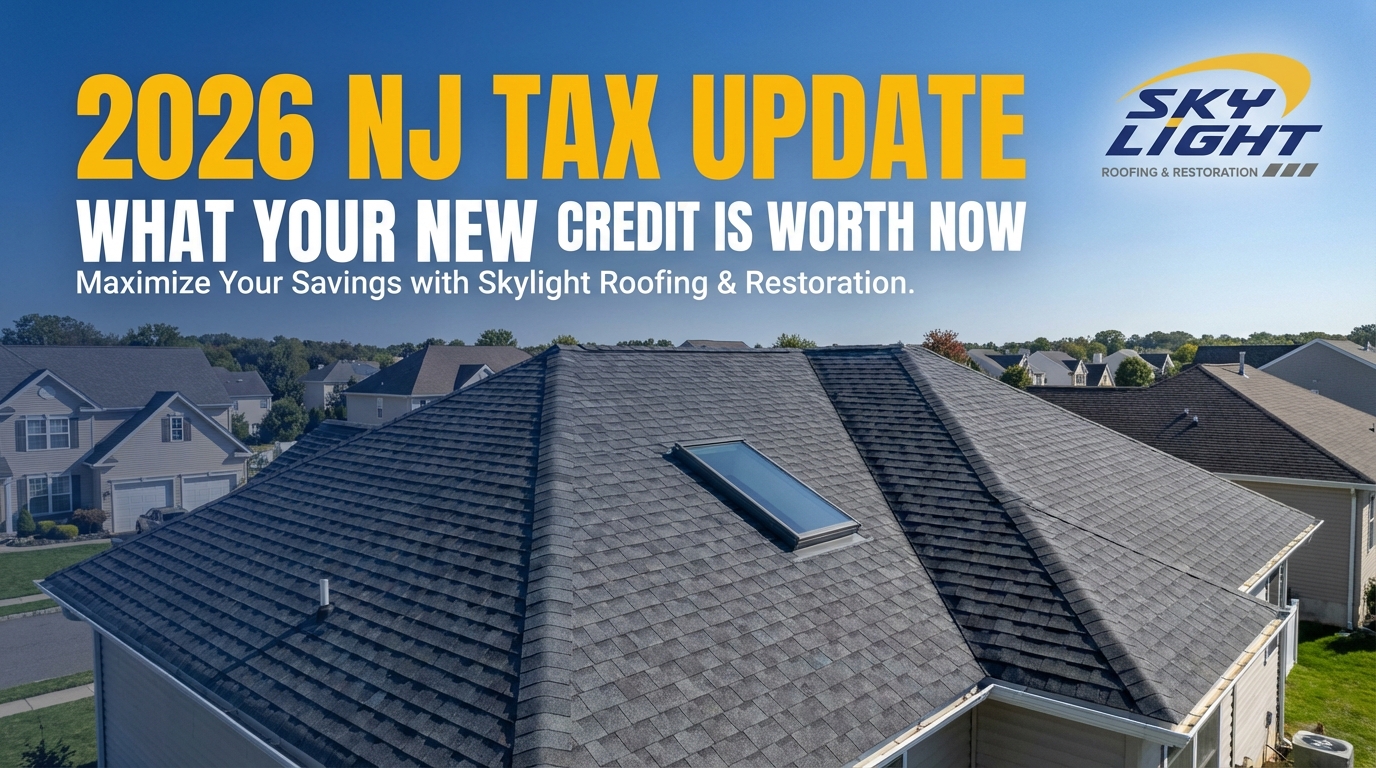
2026 NJ Tax Update: What Your New Roof Credit Is Worth Now
2026 NJ Tax Update: What Your New Roof Credit Is Worth Now
If you are a New Jersey homeowner planning a roof replacement in 2026, you are entering a fiscal landscape that looks significantly different than it did just a few years ago. With the maturation of the Inflation Reduction Act (IRA) and new state-level initiatives like the Stay NJ property tax program, the financial math for home improvements has shifted. Many residents are asking: What is my new roof credit actually worth in 2026? The answer depends on your choice of materials, the inclusion of energy-efficient upgrades, and how you leverage federal and state incentives simultaneously.
Direct Answer for Featured Snippet: In 2026, a standard roof replacement in New Jersey does not qualify for a direct federal tax credit unless it includes solar shingles or specific reflective materials. However, homeowners can claim a 30% uncapped credit (Section 25D) for solar roofing systems, or up to $1,200 annually (Section 25C) for roof-adjacent energy improvements like attic insulation and air sealing. Additionally, the 2026 Stay NJ program provides up to 50% property tax relief, making high-value home renovations more affordable for eligible seniors and families.
Navigating these updates requires a deep understanding of the internal revenue code and local New Jersey mandates. At Skylight Roofing & Restoration, we believe in full transparency, ensuring our clients understand exactly how to maximize their Return on Investment (ROI) through documented inspections and expert guidance. This guide provides the definitive breakdown of the 2026 tax environment for New Jersey roofing projects, helping you secure every dollar you are entitled to under the law.
1. The 2026 NJ Roofing Landscape: Why the Rules Changed
The shifts we see in 2026 are primarily driven by the long-term rollout of federal climate legislation and New Jersey's aggressive clean energy goals. For decades, roofing tax credits were small, sporadic, and often limited to niche "cool roof" products. However, as of 2026, the focus has pivoted toward "Whole Home" efficiency. The legislative intent is no longer just to replace a leaky roof, but to transform the entire building envelope into a thermal barrier that reduces the strain on the state's power grid.
New Jersey has introduced specific bills, such as the One Big Beautiful Bill Act (OBBBA) impact, which streamlined how homeowners interact with third-party leasing for solar and energy upgrades. This change was designed to move away from complex third-party ownership models and toward direct homeowner incentives. By 2026, the "Placed in Service" rule has become the primary metric for eligibility, meaning the date your roof installation is completed and signed off on determines which tax year's rules apply to your claim.
Furthermore, the integration of the Stay NJ program in 2026 adds a layer of property tax relief that previously didn't exist for major home renovations. As roofing costs have risen due to material inflation, these credits and offsets are no longer just "nice to have"; they are essential components of a project budget. Understanding the distinction between a federal tax credit (which reduces your tax bill dollar-for-dollar) and a state rebate (which provides cash back) is the first step in mastering the 2026 update.
2. The Federal Update: Understanding Section 25C and 25D in 2026
The IRS distinguishes between two primary types of residential energy credits: Section 25C and Section 25D. For 2026, Section 25C, also known as the Energy Efficient Home Improvement Credit, provides a capped annual credit of $1,200. While standard asphalt shingles were phased out of this specific category as direct line items, the "Envelope Components"—such as the high-performance insulation and air sealing installed during a roof replacement—are fully eligible. This means that while the shingles themselves might not trigger the credit, the critical weatherization work performed by your contractor does.
Section 25D, the Residential Clean Energy Credit, is the heavy hitter for 2026. This credit remains at 30% of the total project cost for solar electric property, which includes solar shingles and solar tiles. Unlike Section 25C, there is no maximum dollar limit on the 25D credit. If you install a $30,000 GAF Energy Timberline Solar™ roof, your federal tax credit would be a substantial $9,000. This credit is also "roll-over" eligible, meaning if the credit exceeds your tax liability for 2026, you can apply the remaining balance to your 2027 taxes.
It is important to note that the 2026 update emphasizes the "Solar-Ready Zone" retrofitting requirements. New Jersey bills A1866 and A3918 now provide certain pathways for homeowners to claim credits when they prepare their roof for future solar installation. This includes structural reinforcements and specific electrical conduit placements. Even if you aren't ready for full solar panels today, making your roof "Solar-Ready" can unlock specific federal and state-level financial advantages that were unavailable in previous tax cycles.
3. What Your Roof is Worth Now: Calculating the 30% vs. $1,200 Cap
To truly understand the value of your 2026 roof, you must run the math on two different scenarios. In Scenario A, a homeowner chooses a high-quality, standard architectural shingle roof for $18,000 and adds $4,000 in advanced attic insulation and ventilation. Under Section 25C, they would qualify for the maximum $1,200 credit for the insulation portion of the work. The total net cost becomes $20,800. This is a solid investment in home longevity, but the tax relief is capped at that $1,200 ceiling regardless of how much more they spend on efficiency.
In Scenario B, the homeowner opts for an integrated solar roofing system, such as solar shingles, with a total project cost of $35,000. Because this falls under Section 25D, they are entitled to a 30% credit on the entire system—both materials and labor. The credit amount would be $10,500, bringing the net cost down to $24,500. When you compare the two scenarios, the "gap" between a standard roof and a solar roof shrinks dramatically in 2026 due to the uncapped nature of the 30% federal credit.
Standard Architectural $15,000 None (Direct) $0 $15,000 Standard + Insulation $19,000 Section 25C $1,200 $17,800 Solar Shingle System $35,000 Section 25D $10,500 $24,500Furthermore, the 2026 math must account for energy savings over time. A solar-integrated roof doesn't just provide a tax credit; it reduces or eliminates your monthly PSE&G or JCP&L bill. When you combine the 30% federal credit with NJ's SREC (Solar Renewable Energy Certificate) program, many homeowners find that their "break-even" point for a new roof is now under 7 years. This makes the 2026 tax update one of the most favorable windows for high-end roofing investments in New Jersey history.
4. NJ State-Specific Incentives: The Whole Home Energy Efficiency Program
Beyond federal credits, New Jersey offers its own suite of incentives through the NJ Clean Energy Program. In 2026, the "Whole Home" approach has been refined to offer cash-back rebates for projects that improve the home's HERS (Home Energy Rating System) index. If your roofing project includes a transition to Energy Star-certified reflective materials or integrated ventilation systems that reduce cooling loads, you may be eligible for NJ state rebates that stack on top of your federal credits.
One specific 2026 update involves the NJ Comfort Partners program and the Home Performance with ENERGY STAR initiative. These programs provide tiered rebates based on the percentage of energy saved. For example, if a new roof combined with attic sealing reduces your home's energy leakage by 20%, you could qualify for state rebates ranging from $2,000 to $4,000. These are direct payments or point-of-sale discounts, rather than tax credits, providing immediate liquidity for the project.
To unlock these NJ-specific funds, your project usually must be managed by a contractor who understands the rigorous documentation requirements. Skylight Roofing & Restoration specializes in providing the photo-documented inspections and technical specifications required by the NJ Clean Energy Program. We ensure that every component of your roof—from the ridge vents to the ice and water shields—is recorded to prove its efficiency to state auditors.
5. Qualifying Materials: Energy Star Reflective Roofs and Solar Tiles
Not all roofing materials are created equal in the eyes of the IRS or the State of New Jersey. For 2026, the distinction between "standard" and "energy-efficient" is strictly enforced based on Energy Star version 4.0 or 5.0 certifications. Reflective roofing materials, often called "cool roofs," are designed to reflect more sunlight and absorb less heat than a standard roof. These are particularly valuable in New Jersey's humid summers, where they can reduce roof surface temperatures by up to 50 degrees.
Solar shingles, such as the GAF Energy lines, are the gold standard for 2026 tax credits. Unlike traditional bulky solar panels that are bolted onto an existing roof, solar shingles *are* the roof. This means the labor associated with removing your old roof and installing the new solar shingles is often included in the 30% credit calculation. In contrast, if you install panels over an old roof, only the panels—not the roof underneath—qualify for the 25D credit.
Metal roofing also remains a strong contender for 2026 credits. Many high-end metal roofs come with pigmented coatings that meet Energy Star requirements for solar reflectance. While they fall under the $1,200 Section 25C cap, their durability (often 50+ years) and efficiency make them a favorite for homeowners looking for long-term ROI. When choosing materials, always ask your contractor for the manufacturer's certification statement, which you will need to keep for your tax records.
6. NJ Property Tax Relief (Stay NJ) and Its Impact on Your Project Budget
A massive but often overlooked component of the 2026 NJ tax landscape is the Stay NJ program. This legislation was designed to provide significant property tax relief—up to 50% of the property tax bill for eligible seniors and capped at $6,500. While Stay NJ is not a "roofing credit" in the traditional sense, it dramatically changes the affordability of home ownership and renovation in the state. If you are a senior homeowner, the savings from Stay NJ can effectively subsidize the cost of a new roof installation.
Furthermore, New Jersey has strict rules regarding property tax assessments after a renovation. Traditionally, a new roof is considered "maintenance" rather than an "improvement" that triggers a reassessment of your home's value. This is a critical distinction in 2026. By investing in a high-quality roof, you increase the resale value and protection of your home without necessarily increasing your property tax liability—unlike adding a deck or a room addition.
The synergy between Stay NJ and energy credits creates a "perfect storm" of savings. For instance, an eligible homeowner can use their Stay NJ property tax savings to cover the financing payments on a new solar roof, while simultaneously claiming the 30% federal tax credit. This multi-layered approach to financial planning is what differentiates a savvy NJ homeowner from one who simply pays retail price for a replacement. At Skylight Roofing & Restoration, we help you see this big picture during our initial consultation.
7. The BPI-Certified Requirement: Why Your Contractor Choice Matters in NJ
One of the most technical updates for 2026 is the requirement for BPI (Building Performance Institute) certification to unlock certain state-level rebates. New Jersey's Clean Energy Program increasingly requires that contractors performing energy-adjacent roofing work—such as attic insulation and air sealing—hold BPI certification or work through a BPI-accredited firm. This ensures that the "Whole Home" energy savings being claimed are scientifically verified through blower door tests and thermal imaging.
Choosing a contractor who isn't familiar with these 2026 requirements can be a costly mistake. If your contractor doesn't provide the necessary pre-and-post-installation energy audits, you may find your application for state rebates rejected. This BPI standard is meant to protect homeowners from "greenwashing," where a company claims a product is energy-efficient without ensuring the installation meets the rigorous standards required to actually save energy.
At Skylight Roofing & Restoration, we emphasize craftsmanship and clear communication. We understand that a roof is part of a complex system including the attic, ventilation, and insulation. By ensuring your project meets these technical standards, we don't just give you a new roof; we provide the documentation you need to prove its performance to the IRS and state agencies. This level of professional documentation is part of our commitment to a no-pressure, transparent experience for every New Jersey client.
8. Step-by-Step Guide: How to Claim Your Credits Using IRS Form 5695
Claiming your 2026 roofing credits isn't automatic; it requires specific filing during the tax season. The primary document you will need is IRS Form 5695, Residential Energy Credits. This form is divided into two parts: Part I for the 30% clean energy credits (Section 25D) and Part II for the capped energy efficiency credits (Section 25C). You must have your final invoice and the manufacturer's certification statement ready before you begin.
Step 1: Collect Your Documentation. Ensure your invoice from Skylight Roofing & Restoration clearly breaks down the cost of materials and labor. For solar shingles, the labor is usually fully includable. For standard roofs with insulation, ensure the insulation material cost is listed separately from the shingle labor, as only the insulation and air sealing components qualify for the 25C credit.
Step 2: Complete Form 5695. Enter your solar roofing costs on Line 1 of Part I. If you are claiming insulation or reflective roofing under the $1,200 cap, you will fill out the relevant lines in Part II. The form will guide you through the calculation to determine your total credit. Step 3: Transfer to Form 1040. Once you have your total credit from Form 5695, you will enter that amount on your main tax return (Schedule 3). Always consult with a tax professional to ensure your individual tax liability is high enough to fully utilize the credit in a single year.
9. Common Pitfalls: Labor Costs, Secondary Residences, and 'Placed in Service' Deadlines
One of the most common mistakes New Jersey homeowners make is misunderstanding the "Placed in Service" rule. For the 2026 tax year, the project must be fully completed and functional by December 31, 2026. If you sign a contract in November 2026, but the crew doesn't finish the installation until January 2027, you cannot claim the credit on your 2026 taxes. This makes autumn a critical time for scheduling your roof replacement to ensure you don't miss the tax window.
Another pitfall involves secondary residences or rental properties. While Section 25D (Solar) can often be applied to a second home that you live in for part of the year, Section 25C (the $1,200 efficiency credit) is generally restricted to your principal residence. If you are upgrading a shore house in Belmar or a rental property in Jersey City, the tax rules change significantly. Rental properties are usually treated as business assets, requiring depreciation schedules rather than personal tax credits.
Finally, be wary of the distinction between material and labor costs for non-solar projects. Under Section 25C, labor costs for installing insulation or windows are often excluded, whereas labor costs for solar installations under Section 25D are included. Many homeowners see the "30%" figure and assume it applies to everything, only to find out later that their specific material choice (like standard asphalt) doesn't qualify. This is why a detailed, photo-documented proposal from a professional contractor is vital for your tax records.
10. Conclusion: Maximizing Your 2026 NJ Roof ROI
The 2026 tax update has turned the traditional roofing project into a sophisticated financial opportunity. By combining federal credits under Sections 25C and 25D with New Jersey's unique state rebates and property tax relief programs like Stay NJ, homeowners can offset a massive portion of their renovation costs. However, the key to unlocking these savings lies in the details: choosing the right materials, ensuring the project is "placed in service" on time, and working with a contractor who provides the necessary technical documentation.
At Skylight Roofing & Restoration, we take the stress out of this process. We don't just install roofs; we provide a comprehensive restoration service that respects your property and your wallet. Our "no-pressure" approach means we give you the facts about 2026 tax credits and let you make the best decision for your home. With our photo-documented inspections and focus on craftsmanship, you can rest easy knowing your new roof is both a structural and a financial success. Don't leave your tax credits to chance—plan your 2026 project with expertise and clarity.
Ready to Get Started?
We provide complete home renovation services focused on craftsmanship, clean job sites, and clear communication, making the process simple and transparent through photo-documented inspections and a no-pressure experience. Whether you need a standard replacement or a solar-ready upgrade, we are here to help.
Visit Our Homepage