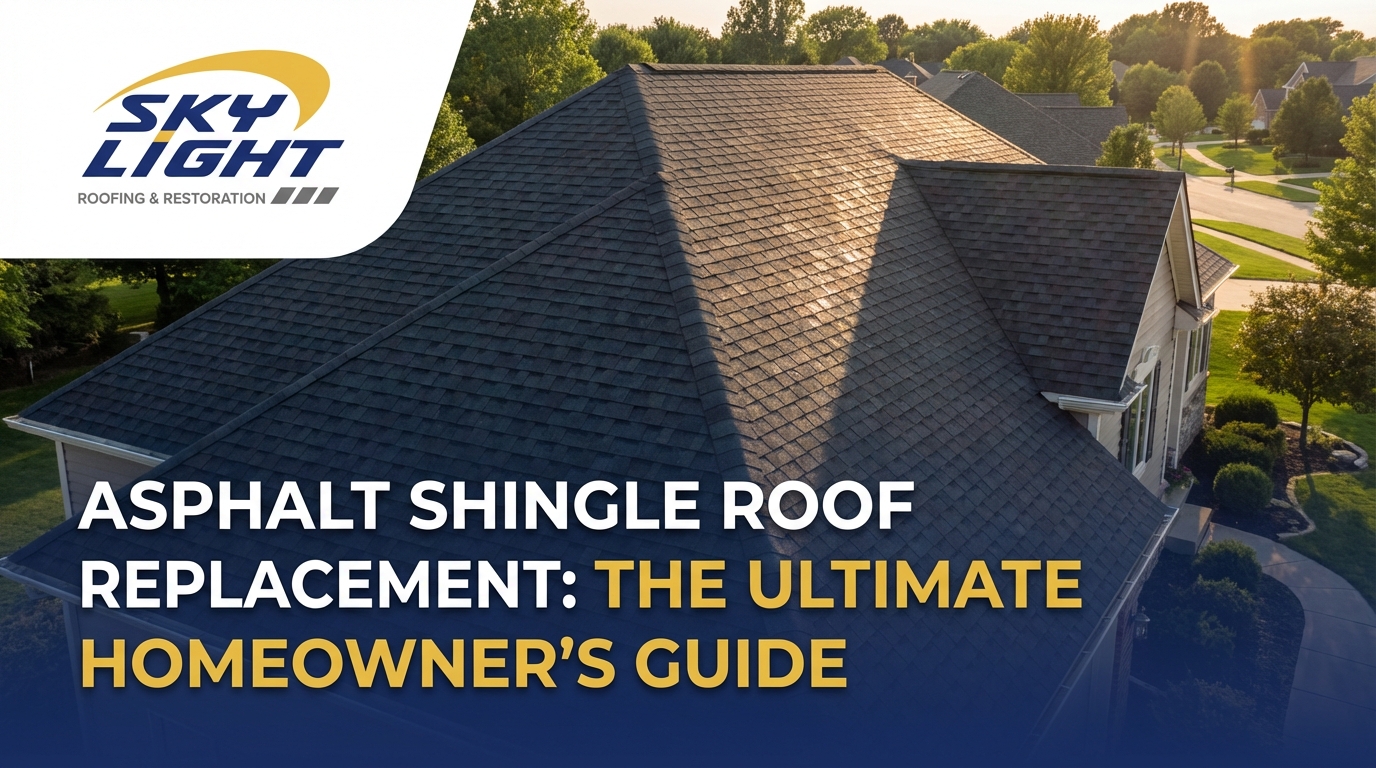
Asphalt Shingle Roof Replacement: The Ultimate Homeowner's Guide
Replacing a roof is one of the most significant investments you will make in your home’s longevity and curb appeal. In the United States, asphalt shingles remain the undisputed champion of roofing materials, covering more than 75% of residential properties. Whether you are dealing with storm damage or a roof that has simply reached the end of its natural lifespan, understanding the nuances of an asphalt shingle roof replacement is essential for protecting your equity. At Skylight Roofing & Restoration, we believe that an informed homeowner is a happy homeowner. This comprehensive guide will walk you through every phase of the process, from initial inspection to final cleanup, ensuring you have the knowledge to make confident decisions for your New Jersey home.
1. Why Asphalt Shingles are the #1 Choice for US Homes
Asphalt shingles dominate the American market for several compelling reasons, primarily their balance of affordability, durability, and aesthetic versatility. Unlike metal or slate, asphalt shingles are relatively easy to install and maintain, which keeps labor costs manageable for the average homeowner. Modern manufacturing has evolved significantly, allowing shingles to mimic the look of wood shakes or natural stone while providing superior fire resistance and wind protection. This versatility ensures that whether you own a colonial, craftsman, or modern ranch-style home, there is a shingle profile that complements your architecture perfectly.
Beyond aesthetics, the performance of modern asphalt shingles is backed by decades of engineering. High-quality shingles are designed to withstand the volatile New Jersey climate, from heavy winter snow loads to the humid, high-wind storms of the summer. With the integration of advanced granules, many shingles now offer algae resistance and reflective properties that help manage attic temperatures. When you choose an asphalt shingle roof replacement, you are opting for a time-tested system that offers the best return on investment (ROI) in the roofing industry today.
Another factor contributing to their popularity is the ease of repair. Unlike seamless systems, if a single area of an asphalt roof is damaged by a fallen branch, a skilled technician can often replace individual shingles without compromising the entire system. However, as shingles age, they lose their flexibility and protective granules, eventually requiring a full replacement. Understanding this lifecycle is the first step in proactive home maintenance and avoiding costly emergency repairs that can arise from sudden roof failures.
2. Phase 1: The Pre-Check (Replacement vs. Repair Decisions)
Knowing When to Repair
Determining whether you need a minor repair or a full asphalt shingle roof replacement is a critical financial decision. Generally, if your roof is less than 15 years old and the damage is localized to a small area—such as a few missing shingles from a windstorm or a minor leak around a chimney pipe—a repair is likely the most sensible route. Repairs focus on restoring the integrity of specific components without disturbing the rest of the system. At Skylight Roofing & Restoration, we provide photo-documented inspections to show you exactly where the issues lie, helping you avoid unnecessary full replacements when a targeted fix will suffice.
Visual Red Flags for Replacement
There are several "telltale" signs that your roof has reached the end of its functional life. Granule loss is one of the most common; if you see what looks like dark sand in your gutters or at the base of your downspouts, your shingles are losing their UV protection. Curling or cupping shingles indicate that the asphalt mat is shrinking and hardening, making them brittle and prone to blowing off. Additionally, if you notice "bald spots" where shingles have lost their texture, or if you see visible light coming through the attic boards, these are urgent indicators that a full replacement is necessary to prevent structural water damage.
Age is the final arbiter. Most standard architectural shingles are rated for 25 to 30 years, but in reality, environmental factors often reduce this functional lifespan to 20 or 22 years. If your neighbors are all replacing their roofs and your home was built at the same time, it is highly probable that your system is nearing its expiration date. Ignoring these signs can lead to mold growth in the attic and rotted support beams, which drastically increases the cost of the eventual replacement.
3. The Hidden Structure: Assessing Decking, Rafters, and Ventilation
The Importance of Sound Decking
A roof is only as strong as the surface it sits upon. The "decking" or "sheathing" is the layer of plywood or OSB boards that are nailed to your rafters. During an asphalt shingle roof replacement, a reputable contractor must strip the old shingles to inspect this wood. If the decking is soft, water-stained, or sagging, it cannot securely hold the nails for the new shingles. Installing new materials over rotted wood is a recipe for disaster, as the nails will eventually "back out," leading to leaks and shingle loss. We always prioritize a thorough deck inspection to ensure your new roof has a solid, nail-ready foundation.
Rafters and Load Bearing
While shingles are relatively lightweight, the cumulative weight of the roofing system is substantial. Rafters must be checked for signs of "deflection" or bowing. This is especially important in older New Jersey homes where original rafters may have been spaced further apart than modern codes allow. If your rafters are compromised, they may require sistering (adding a new board alongside the old one) to provide the necessary support. This structural integrity ensures that your roof remains level and can handle the weight of heavy snow without risk of collapse.
Ventilation is the often-overlooked hero of the roofing system. Without proper airflow, heat and moisture build up in the attic, "cooking" the shingles from the inside out and causing premature failure. A proper replacement includes a review of your intake (soffit) and exhaust (ridge or gable) vents. If these aren't balanced, your warranty may even be voided by the manufacturer. We ensure that your attic temperature stays within 10-15 degrees of the outside air, which also helps lower your energy bills during the hot summer months.
4. The Material Menu: Comparing 3-Tab, Dimensional, and Designer Shingles
When planning your asphalt shingle roof replacement, you will encounter three primary categories of shingles. The first is the 3-Tab Shingle. These are the traditional, flat shingles characterized by three individual tabs on each strip. They are the most budget-friendly option but offer the lowest wind resistance (usually up to 60 mph) and the shortest lifespan. In the modern market, 3-tab shingles are becoming less common for full replacements as homeowners opt for more durable alternatives.
Architectural (Dimensional) Shingles are currently the industry standard. These shingles are composed of two or more layers of asphalt laminated together, giving them a thicker, multi-dimensional appearance. Not only do they look better by hiding imperfections in the roof deck, but they are also much heavier and more durable. Most architectural shingles carry wind ratings of 110 to 130 mph and offer significantly longer warranties. For the majority of our clients, dimensional shingles provide the best balance of price, performance, and aesthetic appeal.
Finally, there are Luxury or Designer Shingles. These are high-end asphalt products designed to replicate the specific look of natural slate or cedar shakes. They are significantly heavier than architectural shingles—sometimes double the weight—and offer unparalleled curb appeal and impact resistance. While the material cost is higher, luxury shingles can dramatically increase the resale value of a premium home. When choosing your material, consider not just the upfront cost, but the long-term value and how the style aligns with your neighborhood's aesthetic standards.
5. The Math of Airflow: How to Calculate Your Home's Ventilation (The 1/300 Rule)
One of the most common reasons for early asphalt shingle roof failure is poor attic ventilation. To ensure your roof lasts as long as the manufacturer promises, contractors use the "1/300 Rule." This building code requirement states that for every 300 square feet of attic floor space, you need 1 square foot of Net Free Area (NFA) for ventilation. This NFA should ideally be split 50/50 between intake (at the eaves or soffits) and exhaust (at or near the ridge). If your contractor isn't performing this math, your new roof is at risk.
To calculate this for your own home, follow these steps: First, determine the total square footage of your attic floor (e.g., 1,500 sq. ft.). Divide that number by 300 to get the total required NFA (1,500 / 300 = 5 sq. ft. of ventilation). Since ventilation products are usually measured in square inches, multiply your result by 144 (5 x 144 = 720 sq. inches). In this example, you would need 360 square inches of intake and 360 square inches of exhaust. Checking this math against your contractor's proposal can save you thousands in future repairs.
Why is this balance so critical? If you have too much exhaust and not enough intake, the ridge vent will begin to pull air from the conditioned space of your home (your living room) or, worse, pull rain and snow backward into the attic. If you have too much intake and not enough exhaust, hot air becomes trapped at the peak, leading to ice dams in the winter and shingle blistering in the summer. A precise asphalt shingle roof replacement must treat the roof as a breathing system, not just a waterproof lid.
6. Phase 2: The Contract & Legal Prep (Lien Waivers and Permits)
Before any shingles are delivered, your legal protections must be in place. A professional roofing contract should be exhaustive. One of the most critical documents homeowners often forget to ask for is the Lien Waiver. In many states, if a contractor fails to pay their material supplier, the supplier can place a lien on your home, even if you paid the contractor in full. A partial lien waiver should be provided with your deposit, and a final unconditional lien waiver should be exchanged for your final payment. This ensures that you are legally protected from third-party claims.
Permit responsibility is another non-negotiable item. Any reputable asphalt shingle roof replacement requires a local building permit. Your contractor should handle the filing and scheduling of inspections. Beware of contractors who ask you to pull the permit as an "owner-builder"; this often means they are unlicensed or trying to avoid liability. The permit process ensures that a neutral third-party inspector verifies the work meets local safety codes, providing you with an extra layer of quality assurance.
Finally, ensure the contract specifies the payment schedule and exact materials to be used. It should list the shingle brand, the type of underlayment (synthetic is preferred over felt), and the specific brand of ice and water shield. At Skylight Roofing & Restoration, we provide a detailed scope of work that includes these legal protections and material specifications, so there is never any ambiguity about what you are paying for or who is responsible for the site's safety and legality.
7. The Budget Breakdown: Visible Costs vs. The 20% 'Hidden' Buffer
When you receive an estimate for an asphalt shingle roof replacement, the price usually covers the "knowns": the square footage, the shingles, the flashing, and the labor. However, because a roof is an opaque system, no contractor can see exactly what is happening beneath the old shingles until they are removed. This is why we strongly recommend homeowners maintain a 20% Contingency Buffer in their budget. This isn't money the contractor expects to spend, but it is a safety net for unforeseen structural issues.
The most common "hidden" cost is rotted decking. On average, replacing a 4x8 sheet of plywood decking costs between $80 and $120 per sheet (including labor). If the roof has been leaking for years, you might find that 10 or 15 sheets need replacement once the tear-off is complete. Other hidden costs can include damaged chimney masonry that was hidden by old flashing, or the discovery of "spaced decking" (common in very old homes) that requires a full overlay of new plywood to meet modern shingle installation requirements.
Pre-1980s Home Alert: Asbestos Considerations
If your home was built before 1980, there is a small but significant possibility that the original layers of shingles or the underlying felt paper contain asbestos. If a contractor suspects asbestos during the tear-off, work must stop for testing and professional remediation. This can add several thousand dollars to a project. While rare in standard asphalt shingle roof replacement, it is a vital safety protocol that protects both the workers and your family from airborne fibers. Knowing this possibility ahead of time prevents "sticker shock" if an environmental issue arises mid-project.
8. Step-by-Step Walkthrough: From Tear-Off to the Final Ridge Cap
The actual day of your asphalt shingle roof replacement will be busy. It begins with property preparation. Our teams use heavy-duty tarps and "Catch-All" systems to protect your landscaping, siding, and windows from falling debris. Once the property is secured, the "Tear-Off" begins. We remove all layers of old roofing down to the bare wood. This is the only way to ensure the new roof has a clean, stable surface and that all underlying rot is addressed.
After the inspection and any necessary deck repairs, we install the critical protective layers. This starts with an Ice and Water Shield—a self-adhering waterproof membrane—installed at the eaves, valleys, and around penetrations like chimneys. Next comes the Underlayment, usually a high-tech synthetic fabric that provides a secondary water barrier. Then, we install starter shingles along the edges to prevent wind uplift. Only after these "invisible" layers are perfect do we begin laying the primary asphalt shingles.
The final stages involve installing the Flashing (metal components that direct water away from walls and chimneys) and the Ridge Vents. The project concludes with a meticulous cleanup. We use high-powered magnetic sweeps to find and remove every nail from your driveway and lawn. A final walkthrough with the project manager ensures that every ridge cap is straight and every vent is secure, leaving your home better than we found it.
9. Post-Replacement Audit: The 5-Point Quality Control Checklist
Once the crew packs up, how do you know the job was done right? At Skylight Roofing & Restoration, we encourage homeowners to perform a final audit. First, check the Flashing. It should be neatly installed and properly sealed; look specifically at the base of the chimney and where the roof meets any siding. Second, inspect the Drip Edge. This metal strip should be installed along the entire perimeter of the roof to lead water into the gutters rather than behind them.
Third, verify the Shingle Alignment. While small variations occur, the rows should be straight and the "overhang" at the eaves should be consistent (usually between 1/2 and 3/4 of an inch). Fourth, ask for Photos of the Decking. A professional contractor should have taken photos after the tear-off to prove that any wood they charged you to replace was actually rotted. This documentation is your proof of value.
Finally, check the Cleanup. Walk the perimeter of your home. You shouldn't find piles of old granules, plastic shingle strips, or stray nails. A clean job site is the ultimate hallmark of a professional asphalt shingle roof replacement. If any of these five points are lacking, a reputable contractor will return immediately to rectify the situation before asking for final payment. Our commitment to craftsmanship means we don't consider the job done until you are 100% satisfied with the result.
10. Maximizing ROI: Tax Credits, Warranties, and Maintenance Schedules
An asphalt shingle roof replacement isn't just an expense; it's an opportunity to save money. If you choose "Cool Roof" shingles that are Energy Star certified, you may be eligible for federal tax credits. These shingles are designed with special granules that reflect more sunlight and absorb less heat, significantly reducing your air conditioning costs. Check with your tax professional to see how the current Energy Efficient Home Improvement Credit (Section 25C) applies to your project.
Understanding your warranties is equally important. There are two types: the Manufacturer’s Warranty (covering material defects) and the Workmanship Warranty (covering installation errors). Most manufacturers offer "Lifetime" warranties, but these are often pro-rated after 10 years. For maximum protection, look for "Extended" or "System Plus" warranties that cover both materials and labor for a longer non-pro-rated period. These are typically only available when you hire a manufacturer-certified contractor.
To keep those warranties valid, you must follow a basic maintenance schedule. This includes cleaning your gutters twice a year to prevent water back-ups and having a professional inspection every 3-5 years. Small issues, like a loosened piece of flashing or a clogged valley, can be fixed for a few hundred dollars before they cause a thousand-dollar leak. Proper maintenance ensures that your new asphalt shingle roof replacement actually lasts its full 25-to-50-year design life.
11. Conclusion: Building Your Home's Permanent 'Roofing Binder'
When your asphalt shingle roof replacement is complete, your job as a homeowner transitions into documentation mode. We recommend creating a "Roofing Binder" (digital or physical) to store all project-related documents. This should include your signed contract, the building permit, the manufacturer’s warranty registration, and the final unconditional lien waiver. Perhaps most importantly, include a copy of the Net Free Area (NFA) ventilation calculations we discussed earlier.
Why go to this trouble? Resale value. When it comes time to sell your home, being able to hand a prospective buyer a complete history of your roof replacement—including proof of quality materials and professional installation—is a massive selling point. It removes the "fear of the unknown" for the buyer and justifies a higher asking price. It shows that you have cared for the property with a high level of professional standards.
At Skylight Roofing & Restoration, we are proud to be the partners who help you build that binder. Our focus on transparent communication, photo-documented inspections, and no-pressure consultations ensures that your roofing journey is smooth and successful. If you're ready to protect your home with a roof built to last, reach out to us today for a comprehensive evaluation.
Ready to Get Your Roof Replaced?
We provide complete home renovation services focused on craftsmanship, clean job sites, and clear communication, making the process simple and transparent through photo-documented inspections and a no-pressure experience.
Visit Our Homepage