NJ Insurance Alert: How Drone Scans Impact Your Roof Coverage
NJ Insurance Alert: How Drone Scans Impact Your Roof Coverage
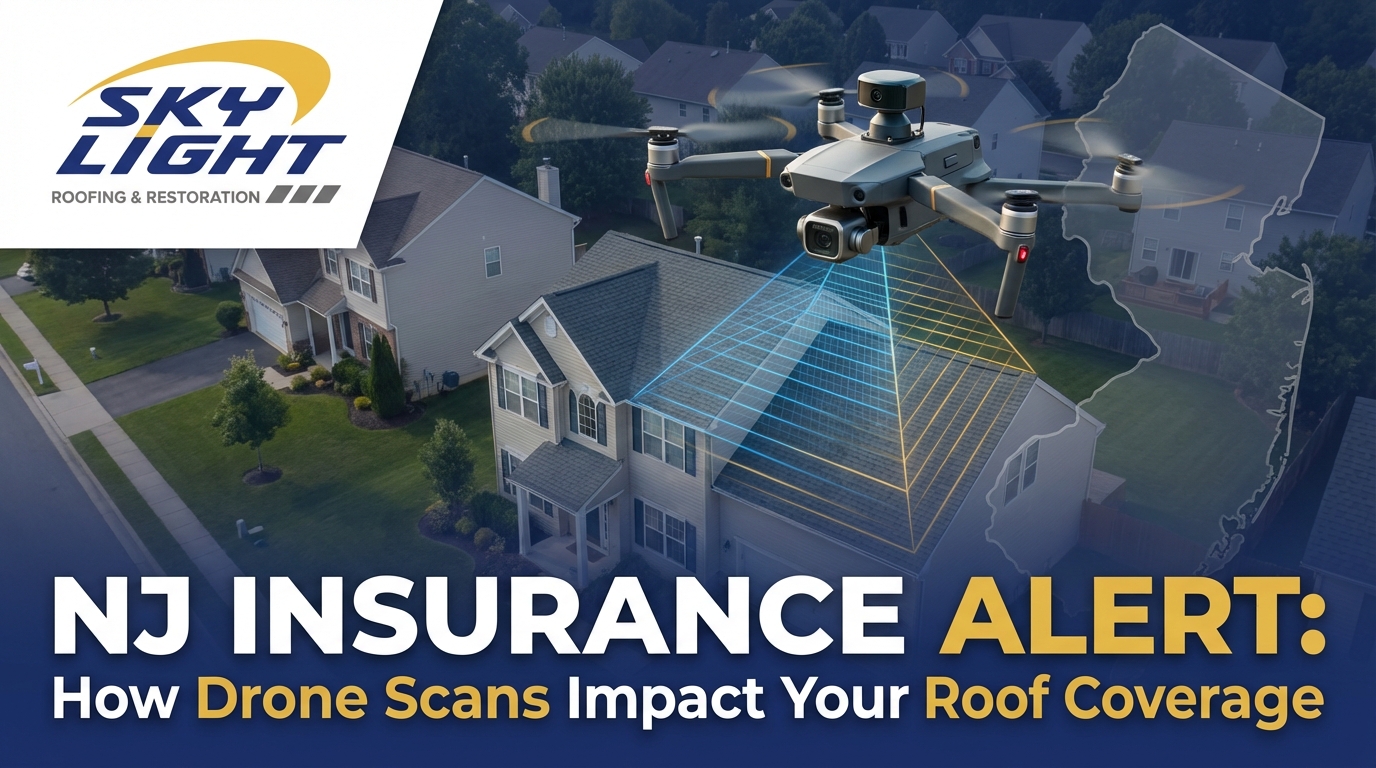
Homeowners across New Jersey are waking up to a new reality: the person inspecting their roof isn't climbing a ladder; they are flying a drone from the sidewalk or using high-altitude satellite imagery. This shift in how insurance companies evaluate property risk has created a significant NJ Insurance Alert: How Drone Scans Impact Your Roof Coverage. While technology offers efficiency, it also brings a wave of automated non-renewals and premium hikes that catch many Garden State residents off guard.
Featured Snippet Answer: Insurance companies in New Jersey are increasingly using high-resolution drone scans and AI algorithms to inspect roofs remotely. These aerial 'sky-adjusters' identify issues like moss, aging shingles, or unreported hazards, often leading to unexpected non-renewal notices or premium hikes, sometimes based on misinterpreted data or shadows. Homeowners have a narrow 30-day window in NJ to contest these findings through professional inspections.
At Skylight Roofing & Restoration, we believe in transparency and professional documentation. As the insurance industry leans more on automated surveillance, the value of a physical, human-led inspection has never been higher. Understanding how these drone scans work, what they look for, and your legal rights under New Jersey law is the first step in protecting your home and your policy from unfair cancellation.
1. The Rise of the 'Sky-Adjuster': Why NJ Carriers Switched to Drones
The traditional model of property insurance involved a human adjuster visiting a home once every few years or after a claim. However, major carriers like Allstate, State Farm, and Liberty Mutual have pivoted toward "aerial underwriting." This involves using a fleet of drones and high-resolution satellite imagery to maintain a constant eye on their portfolio of homes. By removing the need for physical site visits, insurance companies can assess thousands of properties in the time it used to take to assess one, drastically reducing their operational costs.
In New Jersey, where dense suburban neighborhoods and coastal areas provide unique logistical challenges, drones offer a bird's-eye view that a person on a ladder simply cannot match. Carriers use these scans to identify "risk factors" long before a homeowner even thinks about filing a claim. This proactive approach is designed to limit the insurer's liability, but it often puts the homeowner in a defensive position, forced to prove their roof is sound against a grainy digital image.
Efficiency vs. Accuracy
While drones provide high-resolution photos, the interpretation of those photos is often left to Artificial Intelligence (AI). AI algorithms are trained to look for patterns that suggest damage, such as discoloration or uneven textures. However, AI lacks the context of a professional roofer. It cannot feel if a shingle is brittle or see if a leak has actually penetrated the decking. This leads to a high volume of "false positives" where a roof is flagged for replacement despite being functionally sound.
Cost-Cutting for Carriers
The primary driver for this shift is the bottom line. Sending an adjuster to a home in Cherry Hill or Toms River involves travel time, labor costs, and safety liabilities. A drone scan, often performed by a third-party vendor like EagleView or Nearmap, costs a fraction of a human inspection. For the carrier, this data is an asset; for the homeowner, it is a surveillance tool that can be used to justify policy changes or non-renewals without a single word being exchanged.
2. How Drone Scans Directly Affect Your Policy: Premiums vs. Non-Renewals
When a drone scan identifies a potential issue, the insurance company typically takes one of two actions: increasing the premium or issuing a notice of non-renewal. If the drone sees minor wear or the presence of "hazards" like a trampoline or an overhanging tree, the carrier may re-rate your policy. They view these as increased risks that require a higher monthly payment to offset. This is particularly common in NJ Insurance Alert: How Drone Scans Impact Your Roof Coverage discussions, where homeowners see their rates skyrocket without any change in their actual living situation.
A more severe outcome is the non-renewal notice. If the AI determines that the roof is nearing the end of its useful life—typically 15 to 20 years for asphalt shingles—the carrier may simply refuse to renew the policy. This forces the homeowner to find new coverage, which is difficult once a property has been flagged in the industry-wide C.L.U.E. (Comprehensive Loss Underwriting Exchange) database. A roof flagged by one carrier is often avoided by others, creating a stressful cycle for the property owner.
The 15-Year Threshold
Many New Jersey carriers are now implementing strict age limits for roofs. If a drone scan suggests the shingles are showing signs of granules loss or curling, and the permit records indicate the roof is over 15 years old, a non-renewal notice is almost certain. Carriers are moving away from "Actual Cash Value" settlements and toward total risk avoidance, meaning they would rather drop a client than risk a future hail or wind claim on an aging roof.
Impact on Resale Value
Beyond just your monthly bill, these drone scans can impact your home's marketability. If you are trying to sell your home in a competitive market like Montclair or Princeton, a flagged insurance report can kill a deal. Buyers' lenders will require proof of insurability, and if your roof is on a drone "blacklist," obtaining that proof becomes a hurdle that may require a full roof replacement before the sale can close.
3. Anatomy of a Flagged Roof: What the AI Actually Sees (and Gets Wrong)
The AI software used by insurance companies analyzes pixel patterns to determine the health of your roof. However, pixels are not reality. One of the most common issues we see at Skylight Roofing & Restoration is the misinterpretation of cosmetic issues as structural failures. For example, Gloeocapsa magma—a common type of blue-green algae found in New Jersey—creates dark streaks on shingles. To a drone's AI, these black streaks look identical to missing shingles or severe rot, leading to an unfair "hazard" rating.
Shadows from overhanging oak trees or even the angle of the sun during the scan can create optical illusions. A shadow can look like a hole in the roof or a sagging ridge line. Because the carrier relies on the data provided by the software, they often issue notices without verifying the findings with a human eye. This "guilty until proven innocent" approach is the core of the NJ Insurance Alert: How Drone Scans Impact Your Roof Coverage problem.
Common AI Red Flags
- Moss and Algae: Often mistaken for moisture-trapping rot or organic growth that has compromised the shingle bond.
- Debris Accumulation: Leaves in the valleys can be interpreted as "clogged drainage" or structural deterioration.
- Rust on Flashing: Minor surface rust on chimney flashing might be flagged as a high-risk leak point.
- Mismatched Shingles: If you've had a minor repair, the slight color difference can be flagged as a "patchwork roof" signifying overall poor condition.
The Orthomosaic Misconception
Insurers use "orthomosaic" images, which are multiple photos stitched together to create one large, geometrically corrected image. While this is great for measuring the square footage of a roof, the stitching process can create artifacts or "glitches" in the image. These digital glitches can look like cracked tiles or warped shingles, providing the insurance company with a false basis for a non-renewal notice.
4. NJ Homeowner Rights: Understanding the 30-Day Non-Renewal Clock
If your insurance carrier decides to drop you based on a drone scan, they cannot just flip a switch. Under New Jersey law, insurance companies are required to provide a specific notice period before a policy is cancelled or non-renewed. In the Garden State, this is typically a 30-day notice requirement. This is a remarkably narrow window compared to neighboring states like Connecticut, which requires 60 days of notice. This means NJ homeowners have exactly one month to find a contractor, get an inspection, and file an appeal.
The 30-day clock starts the moment the notice is mailed, not when you receive it. Many homeowners lose a week just waiting for the letter to arrive in their mailbox. This creates a high-pressure environment where you must act immediately. If you ignore the letter or delay your response, your policy will lapse, and finding new coverage with a "flagged" roof will be significantly more expensive and difficult.
The Importance of Timely Action
When you receive a notice, the first step is to contact a reputable roofer who can provide a counter-report. At Skylight Roofing & Restoration, we provide photo-documented inspections that specifically address the carrier's concerns. If the drone saw "moss," we can provide high-resolution, close-up photos showing the shingles are intact and only require a professional cleaning. This evidence must be submitted to the carrier's underwriting department within that 30-day window to have a chance at reversal.
Notice Content Requirements
In New Jersey, a non-renewal notice must be specific. A carrier cannot simply say "underwriting reasons." They must state the specific reason for the non-renewal—for example, "roof age over 20 years" or "visible debris and damage noted via aerial imagery." Understanding the specific reason allows you to target your rebuttal. If the notice is vague, you have the right to demand the specific findings and the imagery used to make the determination.
5. Legal Guardrails: NJ Statute 17:36-5.20a and the 'Material Change in Risk' Standard
While insurance companies have the right to manage their risk, they are not above the law. NJ Statute 17:36-5.20a provides protections for homeowners against arbitrary cancellations. Specifically, this statute prevents insurers from dropping a policyholder solely because they filed a claim for weather-related damage, such as wind or hail. Some carriers try to use drone-captured "condition issues" as a workaround, claiming the roof is simply "too old" rather than admitting they are dropping the client to avoid future storm claims.
The legal standard for non-renewal in NJ often hinges on a "material change in risk." The carrier must prove that the property has changed significantly since the policy was first written. If your roof was in the same condition when they renewed it last year, and no major storm has occurred, the carrier may struggle to justify a sudden non-renewal based on a drone scan alone. This is where having a professional roofer's documentation becomes a vital legal tool for your defense.
Challenging the 'Condition' Argument
If a carrier cites "poor maintenance" as a reason for non-renewal, they are essentially claiming a material change in risk. However, if a physical inspection shows that the "moss" is merely surface-level and the structural integrity of the roof remains unchanged, the "material change" argument falls apart. NJ regulators at the Department of Banking and Insurance (DOBI) take these distinctions seriously when a homeowner files a formal complaint.
Protection Against Storm-Related Drops
New Jersey is prone to nor'easters and tropical storms. If you have recently experienced a storm and then received a drone-based non-renewal notice, it is worth investigating if the carrier is trying to bypass NJ's anti-retaliation laws. By labeling your roof as "worn out" rather than "storm damaged," they avoid paying for a replacement and simultaneously remove you from their books. This is a common tactic that requires a professional eye to uncover.
6. The Local Ordinance Angle: When Insurance Drones Clash with NJ Municipal Laws
One of the most complex aspects of the NJ Insurance Alert: How Drone Scans Impact Your Roof Coverage is the legality of the drone flight itself. Many New Jersey municipalities have strict ordinances regarding drone usage. For instance, towns like Ocean City have passed strict no-fly rules for drones to protect the privacy of residents and visitors. If an insurance carrier's drone pilot violates a local ordinance to capture images of your roof, the validity of that evidence may be called into question.
While the FAA controls the airspace, municipalities have authority over where a drone can take off and land. If a drone pilot stands on a public sidewalk in a town with a ban on commercial drone launches, they are in violation of local law. While this doesn't automatically negate the insurance company's right to non-renew, it provides a significant point of leverage in an appeal. Homeowners should check their local municipal codes if they suspect an unauthorized drone has been hovering over their property.
Privacy Concerns in Dense Areas
In densely populated areas like Hudson or Essex County, a drone scanning one roof inevitably captures detailed images of the neighbor's yards, windows, and private spaces. New Jersey has strong privacy expectations, and the use of high-altitude surveillance by private corporations is a growing area of legal debate. If you feel your privacy was invaded, reporting the incident to local law enforcement can create a paper trail that aids in your insurance dispute.
Commercial vs. Private Use
Federal law (Part 107) requires drone pilots to have a commercial license for insurance work. If a carrier uses a third-party service that employs unlicensed pilots, the data gathered may be inadmissible in a regulatory dispute. Always ask for the "flight logs" or the name of the drone operator if you are challenging a notice. Ensuring the carrier followed all state and federal regulations is a key part of the 'fight back' strategy.
7. The 'Fight Back' Protocol: 5 Steps to Challenge a Drone-Based Denial
Receiving a non-renewal notice is not the end of the road. You have the power to contest the findings, but you must move quickly. At Skylight Roofing & Restoration, we recommend the following 5-step protocol for any NJ homeowner who has been flagged by an insurance drone scan. This protocol is designed to provide the carrier with undeniable proof that their AI-driven assessment was incorrect or incomplete.
- Request the Imagery: Demand that your insurance agent provide the specific photos used to flag your roof. You have a right to see the evidence used against you.
- Hire a Professional Roofer: Get a licensed NJ roofing contractor to perform a physical, boots-on-the-roof inspection. Have them take high-resolution, close-up photos of the areas the drone flagged.
- Perform Preventative Maintenance: If the drone flagged "debris" or "moss," have the roof professionally cleaned and the gutters cleared. Document this with "after" photos to show the risk has been mitigated.
- Submit a Formal Rebuttal: Write a letter to the carrier's underwriting department including your contractor's report, photos, and any maintenance receipts. Explicitly state that the "material risk" has been addressed.
- Contact the NJ DOBI: If the carrier refuses to listen despite proof that the roof is sound, file a consumer complaint with the New Jersey Department of Banking and Insurance.
By following these steps, you shift the burden of proof back onto the insurance company. Often, when faced with professional documentation from a company like Skylight Roofing & Restoration, carriers will rescind the non-renewal notice rather than face a potential regulatory inquiry. The key is to be proactive and detailed in your response.
8. Professional Evaluation: Why a Licensed NJ Public Adjuster is Your Best Defense
It is crucial for New Jersey homeowners to understand the legal distinction between a roofing contractor and a public adjuster. While a roofer like Skylight Roofing & Restoration can provide expert technical assessments and perform repairs, we are not legally allowed to negotiate your insurance policy terms or settlements in NJ. That is the role of a licensed Public Adjuster (PA). If your dispute with the insurance company escalates, hiring a PA can be a game-changer.
A public adjuster works for you, not the insurance company. They understand the dense language of insurance policies and can argue technical points regarding the "material change in risk" standard. In the context of NJ Insurance Alert: How Drone Scans Impact Your Roof Coverage, a PA can help you prove that the drone imagery is flawed and that the carrier is violating state statutes. We often work alongside public adjusters, providing them with the technical data they need to win your case.
The Value of the 'Second Opinion'
Insurance companies rely on their own internal adjusters to interpret drone data. These adjusters are paid by the company and have a vested interest in reducing risk. A public adjuster provides a legally recognized second opinion. In New Jersey, if there is a dispute over the condition of a property, having a licensed PA's assessment carries significant weight in court or during a DOBI hearing.
Combining Expertise
The strongest defense is a two-pronged approach: a professional roofer to provide the technical evidence (photos, core samples, shingle analysis) and a public adjuster to handle the legal and policy-based negotiations. This combination ensures that the insurance company cannot hide behind an algorithm or a grainy satellite photo to drop your coverage.
9. Historical Data Comparison: The 'Before and After' Trap
One of the most sophisticated ways insurers use drones and satellites is through historical data comparison. Companies like Nearmap maintain a database of aerial imagery dating back years. When a carrier scans your roof today, they are often comparing it to a scan from three or five years ago. They are looking for "pre-existing damage" to deny future claims. If a drone scan from 2021 shows minor shingle lifting, and you file a claim for a storm in 2024, the carrier may use the old photo to argue the damage was already there.
This is especially prevalent in NJ's coastal areas like Long Beach Island or Cape May, where weather exposure is constant. Carriers use this historical data to create a timeline of deterioration. This underscores the importance of having regular, documented maintenance. If you have photos from a professional roofer from last year showing a perfect roof, you can easily debunk the carrier's "pre-existing" argument based on low-resolution historical satellite data.
The Coastal Risk Profile
For those living on the Jersey Shore, the drone scans are even more frequent. Carriers view these homes as high-risk assets. They use drones to look for salt-spray corrosion on metal components or minor shingle shifting after every major high-tide event. Staying ahead of these scans with a professional maintenance plan is the only way to ensure your coverage remains secure in these vulnerable zones.
10. Conclusion: Future-Proofing Your Roof and Your Coverage in the Drone Era
The age of the "sky-adjuster" is here to stay. As AI becomes more advanced and drone flights become cheaper, New Jersey homeowners should expect their properties to be monitored more frequently than ever before. The best way to survive this NJ Insurance Alert: How Drone Scans Impact Your Roof Coverage is through proactive maintenance and professional documentation. Do not wait for a non-renewal notice to land in your mailbox to check the condition of your roof.
By partnering with a transparent, quality-focused contractor like Skylight Roofing & Restoration, you can build a file of evidence that protects your home. Regular inspections, professional cleaning, and immediate repairs of minor issues ensure that when a drone flies over your home, it sees nothing but a well-maintained, low-risk property. Remember, you have rights under New Jersey law, and with the right team behind you, you can challenge the algorithm and keep your home protected.
Ready to Get Started?
We provide complete home renovation services focused on craftsmanship, clean job sites, and clear communication, making the process simple and transparent through photo-documented inspections and a no-pressure experience. Don't let a drone scan dictate your home's safety—get a professional human perspective today.
Visit Our Homepage