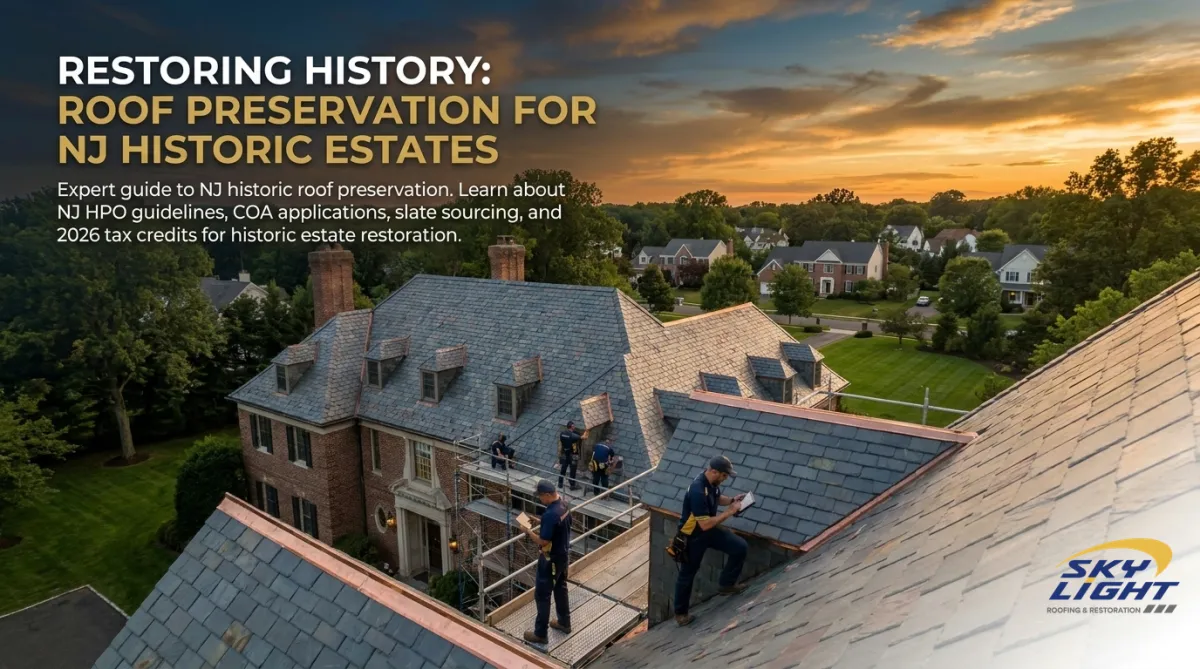
Restoring History: Roof Preservation for NJ Historic Estates
New Jersey is home to some of the nation’s most significant architectural treasures, from the Victorian splendors of Cape May to the stately Colonial mansions of Princeton and Morristown. However, maintaining a historic estate requires more than simple home maintenance; it demands a deep respect for the past and a mastery of traditional craftsmanship. For owners of these legacy properties, the roof is the most critical line of defense against the elements and the most visible indicator of historical authenticity.
Historic Roof Preservation in New Jersey — This refers to the specialized process of maintaining, repairing, or replicating the roofing systems of properties designated as historic landmarks.
Key related topics covered here include Skylight & Vent Installation with practical context for decision-makers.
Key related topics covered here include Roof Repairs, especially Restoring History: Roof Preservation for NJ Historic Estates, with practical context for decision-makers.
When discussing Restoring History: Roof Preservation for NJ Historic Estates, Restoring History: Roof Preservation for NJ Historic Estates is one of the core concepts practitioners align on—this guide explains how it fits your workflow.
At Skylight Roofing & Restoration, we understand that a historic roof is not just a covering; it is a piece of art that defines the character of a 2026 estate. Whether you are navigating the complexities of the NJ State Historic Preservation Office (HPO) or seeking to restore the intricate turrets of a Second Empire Victorian, our expert roof installation team provides the precision and documentation required to preserve your home’s legacy for the next century.
1. What are the NJ State Historic Preservation Office (HPO) roofing guidelines?
In practice, Emergency Roof Leaks: Immediate Steps for NJ Homeowners often shapes how teams execute Restoring History: Roof Preservation for NJ Historic Estates—this section ties that concept to actionable steps.
The New Jersey State Historic Preservation Office (HPO), a wing of the Department of Environmental Protection, oversees the protection of properties listed on the New Jersey and National Registers of Historic Places. Their guidelines emphasize the preservation of original fabric above all else. For a 2026 restoration project, the HPO dictates that original roofing materials should be retained and repaired whenever possible. If the material is beyond salvage, the replacement must match the original in design, color, texture, and other visual qualities.
NJ HPO guidelines often require a detailed condition assessment before any work begins. This includes identifying the specific type of slate or the exact dimensions of cedar shingles used originally. For commercial restoration or larger estates receiving state funding, the HPO may also require oversight to ensure that modern updates—like the addition of a skylight for roof light—do not compromise the historic silhouette of the structure.
Compliance with these guidelines is essential for maintaining a property’s historic status. Failure to follow HPO standards can lead to the loss of registry status and potential legal or financial penalties, particularly if the property is part of a state-funded grant program. Our team at Skylight Roofing & Restoration works closely with preservationists to ensure every nail and shingle meets these rigorous state standards.
2. How to apply for a Certificate of Appropriateness (COA) in NJ historic districts?
Structured, FAQ-rich content on Restoring History: Roof Preservation for NJ Historic Estates often improves scanability and retrieval clarity—especially when sections answer specific questions in plain language.
If your estate is located within a locally designated historic district, such as those in Montclair, Plainfield, or Haddonfield, you must obtain a Certificate of Appropriateness (COA) before beginning any exterior work. The COA is issued by your local Historic Preservation Commission (HPC) and serves as proof that your proposed roof restoration aligns with local aesthetic and historical standards.
The application process generally follows these steps:
- Pre-Application Consultation: Meeting with the local HPC staff to discuss the scope of work.
- Submission of Materials: Providing detailed plans, material samples (e.g., specific slate types), and high-resolution photographs of the existing roof.
- Public Hearing: Presenting the project to the commission for approval, where they evaluate the impact on the neighborhood’s historic character.
- Approval and Permitting: Once the COA is granted, you can proceed to apply for standard NJ Uniform Construction Code (NJ UCC) permits.
At Skylight Roofing & Restoration, we assist homeowners with COA applications by providing technical drawings, material specifications, and photo-documented inspections. This transparency makes the process simple and increases the likelihood of a first-time approval from the commission.
3. Does my New Jersey historic home follow the Secretary of the Interior’s Standards?
The Secretary of the Interior’s Standards for the Treatment of Historic Properties are the gold standard for preservation across the United States. In New Jersey, these standards are frequently cited by both the HPO and local commissions. They categorize work into four distinct treatments: Preservation, Rehabilitation, Restoration, and Reconstruction.
Most NJ residential roofing projects fall under Rehabilitation, which allows for sensitive upgrades—such as improved insulation or skylight & vent installation—while preserving the features that provide the property's historic significance. The standards explicitly state that "the removal of distinctive materials or alteration of features, spaces, and spatial relationships that characterize a property shall be avoided."
Following these standards means prioritizing expert roof installation techniques that mimic the original craftsmanship. For example, if your 1890s estate featured lead-coated copper flashing, replacing it with modern aluminum would likely violate the standards. We specialize in sourcing and installing materials that adhere to these federal guidelines, ensuring your home’s architectural integrity remains intact.
4. What are the best roofing materials for Victorian and Colonial estates in NJ?
Choosing the right material is the most critical decision in historic roof preservation. In New Jersey, the architectural style of the estate usually dictates the material choice. Victorian estates often feature complex rooflines with turrets and gables that require flexible, durable materials like slate or patterned wood shingles. Colonial estates, on the other hand, frequently utilize simpler cedar shakes or standing-seam copper.
| Material | Architectural Style | Longevity | NJ Regional Performance |
|---|---|---|---|
| Slate | Victorian, Tudor, Second Empire | 75–150 years | Excellent for heavy snow loads in Sussex and Morris Counties. |
| Atlantic White Cedar | Colonial, Shore-style, Cape Cod | 30–50 years | Naturally rot-resistant; ideal for humid NJ coastal climates. |
| Copper | Beaux-Arts, Neoclassical, Accents | 100+ years | Unmatched for intricate flashing and salt air resistance. |
For 2026 homeowners, insurance claim support is often necessary when these expensive materials are damaged by NJ's increasingly frequent storms. We provide the detailed documentation insurance adjusters need to justify the higher cost of authentic historic materials over modern asphalt shingles.
5. How to meet NJ Uniform Construction Code (NJ UCC) requirements for historic roofs?
While historic preservation is about aesthetics, the NJ Uniform Construction Code (NJ UCC) is about safety. Balancing the two can be challenging. New Jersey’s building code includes a specific "Rehabilitation Subcode" (NJAC 5:23-6), which provides flexibility for historic buildings. This allows owners to maintain historic features that might not meet modern code requirements, provided they do not pose a safety risk.
Structural load assessments are a vital part of meeting NJ UCC requirements. If you are replacing a lightweight wood roof with heavy Pennsylvania slate, the existing rafters may require reinforcement. Our comprehensive restoration process includes a full structural evaluation to ensure your historic roof can safely handle the weight of the new materials and the 2026 NJ snow load standards.
Furthermore, hazardous material protocols are strictly enforced under the NJ UCC. Many early 20th-century estates contain lead flashing or asbestos-containing mineral tiles. We follow all state and federal guidelines for the safe removal and disposal of these materials, ensuring your restoration is both historically accurate and environmentally responsible.
6. Where to find Pennsylvania slate and authentic cedar shakes for NJ restorations?
Authenticity starts with sourcing. For slate roofs in New Jersey, we prioritize Pennsylvania slate, often referred to as "gray/black" slate, which has been the regional standard for centuries. Sourcing from reputable quarries in the Lehigh Valley ensures that the new tiles will match the chemical composition and weathering characteristics of the original roof.
For wood roofs, we source Atlantic White Cedar or high-grade Western Red Cedar. Atlantic White Cedar is particularly significant in South Jersey and the Pine Barrens, where it was historically the primary building material due to its natural resistance to decay and insects. Using hand-split shakes rather than machine-sawn shingles provides the rugged, textured look essential for authentic Colonial restorations.
Our commitment to reliable maintenance plans includes ensuring that these premium materials are installed using traditional methods. This includes hand-nailing with copper or stainless steel fasteners, which allows for the natural expansion and contraction of the materials—a level of detail often missed by general roofing contractors near me who rely on pneumatic nail guns.
7. What NJ tax credits and grants are available for historic roof preservation?
Preserving a historic estate is a significant financial investment, but New Jersey offers several incentives to help offset the cost. The New Jersey Historic Trust provides various grant programs, such as the Preserve New Jersey Historic Preservation Fund, which are available for capital preservation projects on properties listed in the New Jersey Register of Historic Places.
For income-producing properties (like commercial restoration or historic bed-and-breakfasts), the Federal Historic Preservation Tax Incentive program offers a 20% income tax credit for the rehabilitation of certified historic structures. Additionally, some New Jersey municipalities offer local property tax abatements for homeowners who perform significant restoration work that increases the value of a historic landmark.
When you partner with Skylight Roofing & Restoration, we provide the detailed cost breakdowns and project documentation required to apply for these grants and credits. Our leak repairs and emergency services are also documented to assist with emergency grant applications following storm damage.
8. How to calculate hurricane wind resistance for historic roofs on the NJ coast?
Estates in coastal areas like Spring Lake, Bay Head, and Cape May face unique challenges from high-velocity hurricane zones (HVHZ). In these areas, calculating hurricane wind resistance is mandatory. Modern NJ building codes require roofs to withstand winds often exceeding 120 mph, which can be difficult for traditional historic materials like slate or cedar.
To meet these standards without losing historical accuracy, we employ advanced engineering techniques:
- Enhanced Fastening Patterns: Using more fasteners per slate or shingle than standard installations.
- Stainless Steel Hook Systems: For slate roofs, hooks can provide additional security in high-wind zones.
- Solid Decking Upgrades: Ensuring the roof deck is structurally sound and properly fastened to the rafters to prevent uplift.
Using 3D scanning and drones, we can model wind flow over complex Victorian turrets to identify high-pressure areas. This allows us to reinforce specific sections of the roof that are most vulnerable to storm damage repair needs in the future, providing a 2026 solution for an 1880s home.
9. What is the difference between soft slate and hard slate for NJ estate roofs?
Not all slate is created equal. Understanding the difference between "soft" and "hard" slate is essential for any New Jersey estate owner. Soft slate, common in certain Pennsylvania quarries, has a lifespan of 50 to 75 years. It is more porous and will eventually delaminate as it absorbs moisture and undergoes freeze-thaw cycles.
Hard slate, such as Buckingham Slate or certain Vermont varieties, can last 150 years or more. It is nearly impervious to water and maintains its structural integrity for over a century. In New Jersey’s climate—with its humid summers and freezing winters—choosing a high-quality S1-rated hard slate is almost always the better long-term investment.
During our comprehensive restoration assessments, we perform "ring tests" and acid tests on existing slate tiles to determine their remaining lifespan. This helps homeowners make an informed "repair vs. replacement" decision. If the existing slate is a "soft" variety reaching the end of its life, we often recommend an upgrade to a harder stone to ensure the 2026 restoration is the last one the home will ever need.
10. How to upgrade attic ventilation in a historic NJ home without altering the roofline?
Modern homes use prominent ridge vents and soffit vents, which can ruin the aesthetic of a historic Victorian or Colonial roofline. However, proper ventilation is essential for preventing ice dams and moisture buildup in unconditioned historic attics. The challenge is upgrading attic ventilation invisibly.
We utilize several "hidden" ventilation strategies for NJ historic estates:
- Low-Profile Ridge Vents: Specially designed vents that are covered by the final course of slate or cedar, making them virtually invisible from the ground.
- In-Roof Vents: Small, hooded vents painted to match the color of the slate or copper.
- Gable End Vents: Utilizing existing architectural features like decorative gable windows or louvers to increase airflow.
- Smart Attic Fans: Solar-powered fans installed in locations not visible from the street.
Our skylight & vent installation experts ensure that these upgrades meet 2026 energy efficiency standards while respecting the architectural silhouette. Proper ventilation also extends the life of your roofing materials, making it a critical component of any reliable maintenance plan.
| Strategy | Why it matters |
|---|---|
| Material Matching | Ensures compliance with HPO and COA requirements and maintains property value. |
| Structural Reinforcement | Prevents roof collapse or sagging when switching to heavy materials like slate or tile. |
| Traditional Fastening | Hand-nailing prevents material breakage and allows for natural thermal expansion. |
| Proactive Maintenance | Annual inspections catch small leaks before they damage historic plaster and timbers. |
People Also Ask
How much for a new roof on a historic NJ home?
The cost for a roof replacement on a historic estate typically ranges from $20 to $50 per square foot, depending on materials. Slate and copper are at the higher end, while cedar is mid-range. Factors like roof pitch, height, and the need for structural repairs also influence the final investment.
Are there roofers near me who specialize in slate?
Yes, Skylight Roofing & Restoration specializes in historic materials across New Jersey. It is vital to hire contractors with specific experience in slate, as improper walking on the tiles or using incorrect nails can permanently damage the roof and void warranties.
Can I add a skylight for roof light to a historic home?
Adding a skylight is possible but requires careful planning. To comply with HPO guidelines, skylights should be low-profile and placed on non-primary roof slopes that are not visible from the public right-of-way to preserve the home's historic appearance.
Sources & further reading
Frequently Asked Questions
What is the most common reason for historic roof failure in NJ?
Most failures are not caused by the roofing material itself, but by the failure of the underlying fasteners or the metal flashing in valleys and around chimneys. Copper flashing typically lasts 60-100 years, while the slate it protects can last longer, leading to leaks if the metal isn't replaced in time.
Does Skylight Roofing & Restoration handle insurance claim support for historic homes?
Yes. We provide detailed, photo-documented inspections that help adjusters understand the unique costs associated with historic materials. This ensures your settlement reflects the true cost of an expert roof installation rather than a standard asphalt replacement.
How do I know if I need a COA for my roof repair?
If your home is in a designated historic district, any change in material, color, or texture requires a COA. Minor "in-kind" repairs (replacing a few slates with identical ones) sometimes do not, but you should always check with your local NJ municipal building department first.
What are the benefits of Atlantic White Cedar?
Atlantic White Cedar is native to the NJ coastal plain and offers exceptional resistance to rot and moisture. It weathers to a beautiful silver-gray that is iconic for Shore-style estates and is more sustainable for NJ projects than importing cedar from the West Coast.
How often should a slate roof be inspected?
We recommend a professional inspection every 2 to 3 years. Because slate can be brittle, checking for cracked or slipped tiles after heavy NJ winters or windstorms can prevent major leak repairs and protect the interior of your estate.
Can I use synthetic slate on my historic NJ home?
While synthetic slate is easier to install and cheaper, many local Historic Preservation Commissions (HPCs) do not allow it because it does not age or reflect light the same way as natural stone. Always get approval before considering synthetic alternatives.
What is 'lead flashing' and is it safe?
Lead was traditionally used for its extreme malleability in complex roof joints. While safe when left undisturbed on a roof, it must be handled by professionals during restoration to prevent environmental contamination, often being replaced with lead-coated copper today.
How long does a historic roof restoration take?
A full comprehensive restoration of a large estate can take 4 to 8 weeks. The process is slower than standard roofing because materials are often custom-ordered and traditional hand-nailing techniques are time-intensive.
Content type: Editorial guide
Expertise: Restoring History: Roof Preservation for NJ Historic Estates
Topics: Restoring History: Roof Preservation for NJ Historic Estates Restoring History: Roof Preservation For NJ historic roof restoration historic roofing materials New Jersey
Editorial standards: practical guidance, sourced claims when cited, and updates when practices change.
class="ugo-cta-bridge"> Teams working with Skylight Roofing & Restoration that adopt scalable, evidence-based approaches to Restoring History: Roof Preservation for NJ Historic Estates are better positioned for how search and AI discovery continue to evolve. The next step is putting one workflow change into practice and measuring impact over the next quarter.Ready to Get Started?
We provide complete home renovation services focused on craftsmanship, clean job sites, and clear communication, making the process simple and transparent through photo-documented inspections and a no-pressure experience.