Solar-Ready: How to Prep Your NJ Roof for Future Energy Savings
Solar-Ready: How to Prep Your NJ Roof for Future Energy Savings
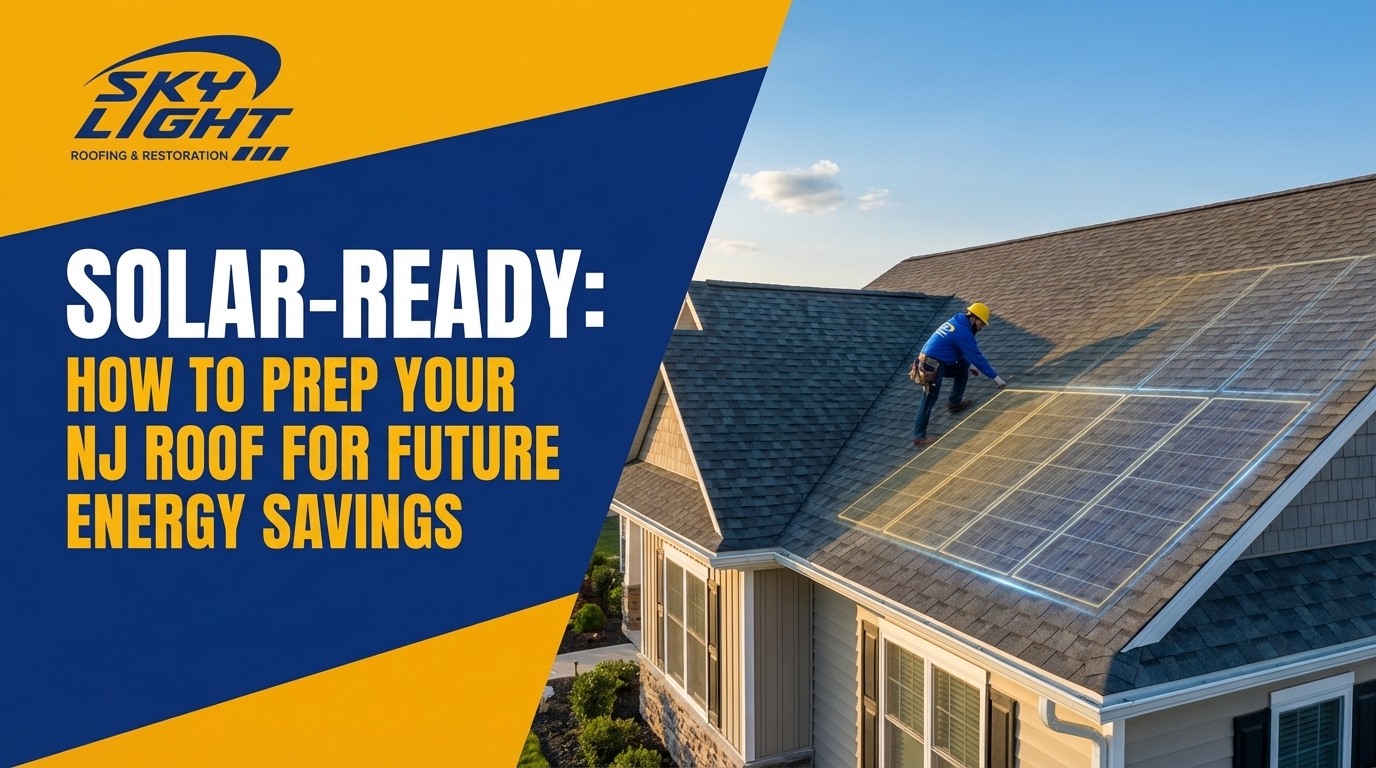
Are you planning a roof replacement in New Jersey but aren't quite ready to pull the trigger on a full solar panel installation? You are in a unique position to "future-proof" your home. In the roofing industry, we call this creating a "Solar-Ready" roof. By making strategic decisions during your roofing project today, you can save thousands of dollars in labor costs later, ensure your home meets evolving New Jersey building codes, and maintain a sleek, high-end aesthetic for your property.
What does it mean to have a solar-ready roof? A solar-ready roof in NJ is a roofing system designed with the structural integrity, material compatibility, and pre-installed electrical pathways necessary to support a photovoltaic (PV) system without requiring future structural modifications or invasive drilling. This involves assessing roof age, reinforcing for snow loads, and optimizing the layout for maximum sun exposure.
1. The Financial Case: Why Prepping Your Roof Now Saves Thousands Later
One of the most common mistakes New Jersey homeowners make is installing solar panels on a roof that only has 5 to 10 years of life remaining. When that roof eventually fails, the solar panels must be professionally decommissioned, removed, stored, and reinstalled after the new roof is complete. This "Remove and Reinstall" (R&R) process typically costs between $3,000 and $6,000 depending on the size of the array. By syncing your roofing and solar timelines, you eliminate this massive redundant expense entirely.
Maximizing the Federal Investment Tax Credit (ITC)
Under the current Inflation Reduction Act, homeowners can claim a 30% federal tax credit for solar energy systems. While this credit is stable through 2032, the solar industry is watching closely for potential shifts in policy. Furthermore, many homeowners don't realize that certain "solar-ready" roofing reinforcements may qualify for a portion of these tax benefits if they are deemed essential for the solar installation. Preparing now ensures you are locked in for these incentives before any legislative sunset dates or modifications occur in 2026 and beyond.
New Jersey’s Successor Solar Incentive (SuSI) Program
New Jersey has one of the most robust solar markets in the country. The SuSI program provides SREC-II (Solar Renewable Energy Certificates) which pay you for every megawatt-hour of electricity your system produces. By having a solar-ready roof, you can jump on these incentives the moment your budget allows, rather than waiting months for a roof replacement that could have been handled earlier. This speed-to-market allows you to start generating passive income from your roof much sooner.
2. Assessment Phase: Determining Your Roof’s Age, Health, and Lifespan
Before you can even think about solar, you must evaluate the "chassis" of your home: the roof deck and the existing shingles. Solar panels are warrantied for 25 to 30 years. If your current roof is already 12 years old, it will not survive the lifespan of the panels. At Skylight Roofing & Restoration, we recommend that any roof with less than 15-20 years of remaining life be replaced prior to solar installation to ensure the two systems age in tandem.
The Importance of a Photo-Documented Inspection
A professional inspection for a solar-ready roof goes deeper than a standard leak check. We look for signs of deck rot, sagging rafters, or compromised underlayment. We provide a detailed photo report showing the condition of the plywood decking. If the decking is thin or weathered, it won't hold the lag bolts required for solar racking. Replacing the decking during a roof job is relatively inexpensive; doing it after solar is installed is a nightmare scenario.
Evaluating Granular Loss and Shingle Integrity
Even if a roof looks "okay" from the ground, excessive granular loss means the asphalt is becoming brittle. The heat generated between the solar panels and the roof surface can accelerate this aging process. A solar-ready roof starts with a high-durability architectural shingle or metal system that can withstand the micro-climate created under a solar array.
3. NJ Building Codes: Navigating Structural Load and Wind Resistance Standards
New Jersey’s geography presents unique challenges for solar. We deal with heavy humid summers, coastal wind gusts, and significant winter snow loads. A solar array adds roughly 3 to 4 pounds per square foot of dead weight to your roof. While that sounds small, it changes the way your home handles the "live load" of a heavy Jersey snowstorm. If your rafters are spaced too far apart or are undersized, your roof could bow or fail under the combined weight.
NJ-Specific Snow Load Requirements
Depending on your county, NJ building codes require roofs to support between 20 and 30 pounds per square foot of snow. When panels are added, they can sometimes cause snow to slide and accumulate in "drifts" on lower roof sections or create a concentrated weight load on the racking points. During a solar-ready prep, we evaluate if your attic needs collar ties or sistered rafters to ensure your home meets the International Building Code (IBC) standards adopted by New Jersey.
Wind Uplift and Coastal Considerations
For our clients in Ocean, Monmouth, and Atlantic counties, wind is a primary factor. Solar panels act like sails; if they aren't anchored to a roof that is properly fastened to the structure, the entire system can be compromised during a Nor'easter. Preparing a solar-ready roof involves using enhanced fastening patterns for shingles and ensuring the roof deck is nailed with ring-shank nails to prevent uplift.
4. Material Selection: Best NJ Roofing Materials for Future Solar Mounting
Not all roofing materials are created equal when it comes to solar. While you can install solar on almost any surface, some materials make the process significantly safer and more cost-effective. Choosing the right material now is the cornerstone of a solar-ready strategy.
Standing Seam Metal: The Gold Standard
If you are serious about solar, a standing seam metal roof is the ultimate choice. Why? Because solar installers can use specialized clamps (like S-5! attachments) that grip the raised seams of the metal. This means zero penetrations in your roof. No holes, no lag bolts, and virtually zero risk of leaks. While the upfront cost is higher, a metal roof will likely outlast the solar panels themselves, lasting 50+ years.
Architectural Asphalt Shingles
For most NJ homeowners, high-quality architectural (laminated) shingles are the standard. If you go this route, choose a shingle with a high wind rating and a heavy weight. Avoid thin, three-tab shingles, which are prone to cracking when installers walk on them to mount the racking system. We recommend brands like GAF or CertainTeed that offer specialized underlayments that can withstand the high heat levels common under solar arrays.
Preparing for BIPV (Building Integrated Photovoltaics)
Solar technology is shifting toward solar shingles (like the Tesla Solar Roof) or solar tiles. These systems replace your roofing material entirely rather than sitting on top of it. If you are considering BIPV in the future, your solar-ready prep involves ensuring your roof deck is perfectly flat and that your electrical panel has the capacity for a high-output DC-to-AC conversion system.
5. The ‘Conduit-Ready’ Advantage: Pre-Installing Wiring Paths for a Cleaner Look
Nothing ruins the curb appeal of a beautiful New Jersey home like thick, silver metal pipes (conduit) running across the roof and down the side of the siding. This is the hallmark of a rushed solar job. When you prep your roof for solar during a replacement, you can avoid this entirely by creating an internal conduit path.
Step-by-Step Conduit Pre-Installation
While the roof is stripped down to the deck, a roofer or electrician can install a 1-inch or 1.5-inch EMT or PVC pipe from the attic space through the roof deck, finishing it with a waterproof "Soladeck" or similar flashing box. This box sits flush with the shingles. When the solar installers come 2 years later, they simply open the box, pull their wires through the pre-installed pipe, and connect them in the attic. The wiring is hidden, protected from the elements, and requires no exterior wall penetrations.
Solar-Ready Flashing and Mounts
Another pro-tip for a solar-ready roof is to have your roofer install the flashing-integrated mounts during the shingle installation. Using products like IronRidge or Quick Mount PV ensures that the most vulnerable part of the solar system—the roof penetration—is handled by a professional roofer who understands water-shedding cycles, rather than a solar technician who may not have roofing expertise. This keeps your roofing warranty fully intact.
6. Orientation and Layout: Dealing with Vents, Dormers, and NJ Shading Issues
A roof’s ability to produce energy is dictated by its geometry. In New Jersey, the ideal solar orientation is South-facing at a pitch of 30 to 45 degrees. However, many NJ homes have complex rooflines with dormers, gables, and plumbing vents that "break up" the available space for panels. Part of being solar-ready is optimizing this layout before the panels arrive.
Relocating Plumbing Vents
Plumbing stacks and attic vents often pop up right in the middle of a prime south-facing roof plane. A solar installer might have to work around them, leaving gaps in your array that look unsightly and reduce efficiency. During a roof replacement, we can often relocate these vents to the North-facing slope or consolidate them, creating a large, unobstructed rectangular area perfect for a high-density solar array.
Shading Analysis and Tree Management
NJ is known for its beautiful oak and maple trees, but they are the enemy of solar production. As part of a solar-ready assessment, we evaluate the "solar window" of your roof. This might be the time to trim back overhanging branches that are not only shading your future panels but also dropping debris that leads to roof rot and clogged gutters. Removing these obstructions now ensures your roof is healthy and your future energy production is maximized.
7. New Jersey Specifics: Permitting, Local Utility Requirements, and State Mandates
New Jersey has some of the strictest and most varied municipal building codes in the Northeast. What is allowed in Toms River might be different than in Princeton. Understanding these local nuances is critical when building a solar-ready roof. Furthermore, New Jersey recently passed the A3352 mandate, which requires new warehouses of a certain size to be solar-ready. While this doesn't apply to residential homes yet, it signals a statewide shift toward solar-ready construction as the new standard.
Utility Interconnection: PSE&G vs. JCP&L
Each utility company in NJ has different requirements for where the solar meter and disconnect switch must be located. If you are prepping your roof, you should also look at your main electrical panel. Most solar systems require a 200-amp service. If your NJ home still has an old 100-amp or 150-amp panel, upgrading this during your roofing/renovation phase is much more efficient than doing it later as a standalone electrical project.
The 2026 Financial Cliff and Strategic Timing
With various state and federal incentives having potential expiration dates or step-downs around 2026, many NJ homeowners are rushing to get systems installed. However, the worst thing you can do is rush into a solar contract on a bad roof. By taking the "Solar-Ready" approach now, you put yourself in a position of power. You get the quality roof you need today, with all the infrastructure in place to capture the best possible incentives when the market is right for you.
8. Beyond the Panels: Reflective Underlayment and Insulation for Immediate Energy Savings
A truly solar-ready roof is part of a larger "Energy-Ready" home strategy. Even before the panels are installed, the way your roof is built can lower your utility bills. Solar panels actually shade your roof, which can help cool the attic, but you can go further by choosing the right underlying components.
Radiant Barriers and Reflective Underlayment
Installing a synthetic underlayment with heat-reflective properties can reduce the amount of thermal energy transferred into your attic. When you eventually add solar panels, this creates a double-layer of protection against NJ's summer heat. This keeps your home cooler and reduces the load on your AC unit, which in turn means you'll need fewer solar panels to cover your energy needs later.
Optimizing Attic Ventilation
Solar panels require an air gap between the panel and the roof to prevent overheating (which reduces efficiency). Similarly, your attic needs a robust intake and exhaust system to prevent moisture buildup. A solar-ready roof should utilize ridge vents and soffit vents that won't be blocked by the future solar array. We carefully plan the placement of these vents so they can function perfectly even when the roof is 80% covered by panels.
9. Summary: Your Solar-Ready Checklist
To summarize, prepping your NJ roof for solar is a multi-step process that requires coordination between roofing expertise and solar foresight. If you are replacing your roof this year, ensure your contractor addresses the following items:
- Decking Quality: Verify that plywood is at least 1/2 inch thick and free of rot.
- Structural Reinforcement: Check rafter span for NJ snow load compliance.
- Material Choice: Opt for architectural shingles or standing seam metal.
- Conduit Path: Install an internal pipe from attic to roof for hidden wiring.
- Vent Relocation: Move plumbing stacks to the North slope to clear South-facing space.
- Electrical Prep: Ensure your main panel is 200-amp ready.
- Documented Warranty: Get a workmanship warranty that specifically covers future solar penetrations if the roofer installs the mounts.
10. Conclusion: Building a Roadmap for Your Future Solar Transition
Investing in a solar-ready roof is one of the smartest decisions a New Jersey homeowner can make. It demonstrates a commitment to long-term property value, energy independence, and architectural integrity. By spending a little extra time and resources today to prep your structure, you avoid the headaches of invasive retrofitting, unsightly exterior wiring, and the high costs of "removing and reinstalling" panels down the road.
At Skylight Roofing & Restoration, we don’t just slap on shingles; we build systems that are designed for the future of your home. Whether you plan to install solar next year or ten years from now, our goal is to ensure your roof is prepared for the challenge. We provide the photo-documented inspections and transparent communication you need to make an informed decision about your home’s most critical asset.
Ready to Future-Proof Your Home?
We provide complete home renovation services focused on craftsmanship, clean job sites, and clear communication, making the process simple and transparent through photo-documented inspections and a no-pressure experience.
Visit Our Homepage